India's Brand-Building Revolution Has a New Playbook
Ten years ago, launching a consumer brand in India meant one thing: capital. You needed a distributor network, a TV commercial budget, retail shelf space, and probably a celebrity contract you could barely afford. The barrier to entry was so high that most ideas never made it past a notebook.
Today, a founder in Bengaluru with a great product, a clear Instagram strategy, and access to the right creators can build a crore-worth brand from her laptop. That is not an exaggeration; that is what happened, over and over again, across India's D2C ecosystem.
India now has over 100 million creators across platforms, and the D2C startup ecosystem has exploded with thousands of new consumer brands entering the market every year. From beauty and wellness to fashion and personal hygiene, Indian startups are no longer waiting to get big before they market; they are using influencer marketing to get big in the first place.
The brands that figured this out earliest did not just grow faster. They became category leaders.
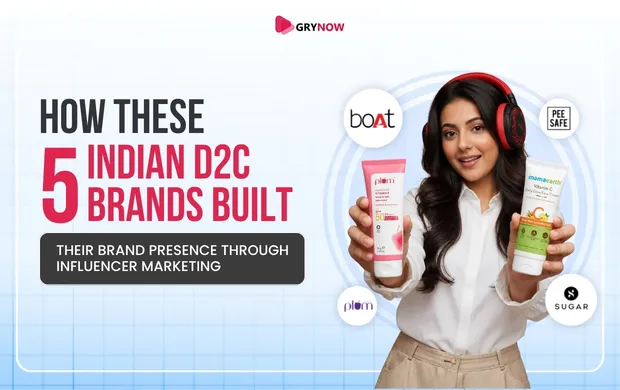
Plum, Boat, Mamaearth, Sugar Cosmetics, and Pee Safe are five very different brands from five very different categories, but they share one thing in common: they built their presence, trust, and customer base through creator-first marketing strategies long before traditional advertising could have done the job.
Here is how each of them did it.
Plum Turned Skincare Creators Into a Credibility Engine
When Plum launched as a vegan, toxin-free beauty brand, its biggest challenge was not product; it was trust. Clean beauty was a new concept for most Indian consumers, and convincing someone to switch from a brand they had used for years required more than a paid ad. It required education.
Plum's CMO, Shivani Behl, confirmed that the brand invested heavily in top-of-the-funnel awareness activities; approximately 60% of its ad spend went into building brand recognition. Rather than relying on expensive celebrity deals, Plum partnered with skincare influencers and dermatologist creators, people who could explain why vegan formulations matter, why a pH-balanced cleanser is different from a regular face wash, and what "no nasties" actually means for your skin.
The result was a brand built on informed trust rather than aspirational association. Skincare enthusiasts with 20,000–80,000 followers who tested products rigorously and shared honest reviews gave Plum a credibility that no billboard could. Their audiences trusted their skin advice the way they trusted a knowledgeable friend. And when that friend recommended Plum, the conversion followed naturally.
This is the clean beauty blueprint: education over promotion, micro-influence over mass reach, and trust over hype.
BOAT Became a Lifestyle Brand, Not Just a Tech Brand
Think about what the boAt was selling at launch: earphones and cables. Categories were so saturated and so commoditized that the only typical differentiator was price. But BoAt did not position itself as a tech brand; it positioned itself as a lifestyle brand for young India.
The strategy was sharp and deliberate. BoAt partnered with music creators, college student influencers, gaming content creators, fitness vloggers, and eventually cricket and Bollywood icons. By the time Kartik Aaryan was fronting their campaigns and the brand had signed 14 brand ambassadors from across entertainment and sports, boAt had already built its cultural identity through thousands of smaller creator touchpoints.
Celebrity endorsements increased BoAt's brand recall by over 60% in Tier 1 and Tier 2 cities (Digital Course AI, 2025). But that macro reach would have meant nothing without the micro foundation, the gaming influencers who reviewed their earphones honestly, the college students who tagged boAt in their study session reels, and the music producers who showed the earphones in the background of their studio videos.
The brand's appearance on Shark Tank, with co-founder Aman Gupta as a judge, further amplified what creator marketing had already built. By FY 2024–25, boAt crossed ₹4,000 crore in annual revenue and held the largest market share in India's wearable and hearable category as of Q1 2025 (IDC India).
The lesson from boAt: creators do not just sell products; they define what kind of person uses the product. Get that identity right through the right creators, and price becomes secondary.
Mamaearth Scaled From Parenting Bloggers to a ₹10,000 Crore Company
Mamaearth's founding story is rooted in a real problem. Co-founders Varun and Ghazal Alagh could not find toxin-free baby care products in India that met international safety standards. So they made their own. And when it came time to market them, the choice of channel was obvious: go where new mothers already gather and trust.
They started with parenting bloggers and mommy influencers who were documenting real journeys of motherhood and who had earned the deep trust of an extremely protective audience: parents of newborns. A mother recommending a baby shampoo to 15,000 other mothers who follow her journey is one of the most powerful marketing moments possible. It is not an ad; it is a recommendation with stakes.
As Mamaearth scaled, so did its influencer strategy. The brand moved from micro-influencers to mid-tier creators to eventually signing celebrity ambassadors like Shilpa Shetty and Samantha Ruth Prabhu. But the foundation was always the grassroots creator trust it built in the early years. That trust was what allowed its "toxin-free" positioning to become a genuine market differentiator rather than just a marketing claim.
Mamaearth's journey from a bootstrapped startup to a company that is listed on Indian stock exchanges at a valuation of over ₹10,000 crore is perhaps the most powerful proof point for what creator-first marketing can build when executed consistently over the years.
Pee Safe Normalised a Taboo Category That Traditional Ads Could Never Touch
Imagine trying to market a toilet seat sanitizer in India in 2013. Try pitching that to a TV channel. Try putting it on a billboard. The category was so sensitive, so culturally charged, and so completely outside the vocabulary of mainstream Indian advertising that traditional media would have been both ineffective and nearly impossible to access.
Pee Safe had to do something different. They went digital, and specifically, they went with influencers because the only way to open a conversation about intimate hygiene and menstrual care is through voices audiences already trust and feel safe with.
In their early years, Pee Safe leaned on organic reviews from users with 500 to 3,000 followers who genuinely talked about the product's utility. These were not paid campaigns; they were real people solving a real problem and sharing it. That word-of-mouth, amplified through creator content, built the brand's foundational trust. By 2018, they had scaled into formal influencer partnerships, working with female health creators and educators who could speak to their audience on topics that TV and print had always shied away from.
Their #MenBuyPads campaign enlisted male influencers to break the taboo from an unexpected angle. Their 'It's Just Periods' ad challenged the euphemistic language that Indian menstrual hygiene advertising had relied on for decades. And their podcast, Pee Room Conversations, built a community platform around topics of women's hygiene, body image, relationships, and sexual health that traditional media had kept in whispers.
Today, Pee Safe's toilet seat sanitizer holds over 90% market share in its category. What built that dominance was not a celebrity deal. It was thousands of authentic conversations sparked by creators who made it safe to talk about something that had always been treated as unspeakable.
Sugar Cosmetics Let Creators and Its Founder Build the Brand Simultaneously
Sugar Cosmetics had a clear gap to fill: international brands dominated India's premium makeup market but consistently ignored Indian skin tones, humid climates, and the need for long-lasting formulas that actually work in Indian weather. Vineeta Singh and Kaushik Mukherjee built Sugar to address that gap, and they built the brand voice through creators who understood it instinctively.
The early strategy was Instagram-led and deeply influencer-driven. Micro- and mid-tier beauty influencers, makeup artists, everyday users, and beauty reviewers were among Sugar's most important early marketing assets. They tested products, created tutorials, and drove the kind of word-of-mouth that made Sugar's product launches feel like community events rather than brand announcements (BIBS, 2024).
What made Sugar's influencer strategy unique was its founder's own creator presence. Vineeta Singh built a significant personal brand on LinkedIn and Instagram, sharing her marathon journey, her entrepreneurship story, and her belief in building a brand that genuinely works for Indian women. That founder-as-creator approach gave Sugar an authenticity layer that no paid influencer campaign could fully replicate. People trusted the brand partly because they trusted her.
Sugar eventually scaled its collaborations to include celebrities like Ranveer Singh and Tamannaah Bhatia. But the brand's identity was already set: affordable, bold, Indian, and backed by a community that felt like it co-owned the brand's journey.
How We Help Brands Replicate What These Winners Did
Grynow – a top influencer marketing agency in India, renowned for delivering high-converting campaigns by leveraging winning influencer strategies and partnerships with the right influencers to drive high conversion rates and engagement.
Grynow doesn't just connect brands with influencers; it helps brands build the same creator-first strategy that India's fastest-growing D2C brands have used to scale.
Here's how:
Rather than running one-off posts, Grynow designs campaigns that work across the entire funnel from awareness through micro-influencer seeding to conversion through dedicated review videos and affiliate integrations. Each stage of the funnel is mapped to the right creator tier, content format, and platform, so brands are not just generating impressions but moving consumers from discovery to purchase.
Also, Grynow specializes in micro-influencer marketing, which includes activating hundreds of creators simultaneously to generate authentic UGC at scale. Micro-influencers in India bring higher engagement rates, deeper community trust, and more relatable content, making them the most cost-effective seeding tool available to D2C brands today.
This is the exact approach that India's top D2C winners have used to turn influencer marketing from a brand awareness tool into a direct revenue channel.