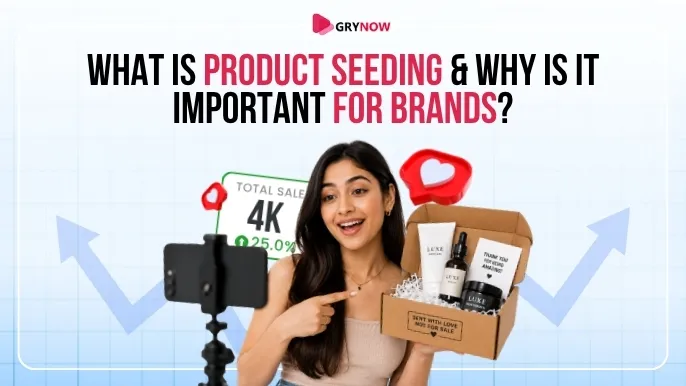
Suppose a skincare founder sent eight jars of her new moisturizer to creators who'd never heard of her brand. No contract, no brief, no payment. Just a box and a handwritten note tucked inside. Some days later, one of those creators posted a 40-second unboxing video, and the brand had its biggest sales day since launch after that post.
It's no longer a rare strategy. Today, every small and mid-size brand does this regularly, and a lot of marketers are quietly asking why this tactic that costs less than one paid ad set keeps beating campaigns with ten times the budget.
This is because this strategy comes with no formal obligation, and when the person shares a review about any product, it comes most organically.
Before knowing how it works, let's understand what product seeding is.
What Is Product Seeding?
Product seeding, often referred to as barter collaboration or influencer gifting, is the process of sending free products to creators, customers, or media contacts without a formal paid contract requiring them to post, review, or mention the brand at all. Many brands use this strategy to build authentic creator collaborations and generate organic content around their products.
If something comes out of it, such as a story, a haul video, or an unexpected review, that's a bonus. Nobody signed anything promising it.
That's really the whole difference between a product seeding campaign and a paid influencer collaboration.
Paid deals typically come with a detailed brief, agreed deliverables, a fixed fee, and a defined posting schedule. On the other hand, product seeding is more flexible. Brands send products to creators in the hope that they'll genuinely enjoy them and choose to share their experience. Many businesses also use product seeding as an initial step to identify creators who naturally connect with their products before investing in larger influencer campaigns.
Many brands use barter collaborations as part of their product seeding strategy, especially when working with micro and nano influencers in India, since the focus is on exchanging products for authentic brand exposure rather than large advertising budgets.
As product seeding campaigns grow, managing creator outreach, product shipments, follow-ups, and performance tracking can quickly become time-consuming. Brands are looking for a top barter influencer marketing agency to streamline campaign execution, identify the right creators, and build long-term creator relationships more efficiently.
Product Seeding Vs Paid Influencer Marketing
| Product Seeding | Paid Influencer Marketing |
|---|---|
| No contract: the product is simply gifted freely without any obligation | Fully contracted upfront: deliverables, usage rights, and fee agreed before anything ships |
| No coverage guarantee: creator decides if it's worth mentioning | Coverage guaranteed as part of the deal |
| Cost of product only | Product cost (if any) + fee |
| Feels more genuine since it isn't obligated | Clearly sponsored, recognized as an ad by audiences |
| Little control over messaging or timing | Full control over messaging, format, and posting schedule |
| Building organic buzz and long-term goodwill | Guaranteed reach or a specific campaign outcome |
Why Is Product Seeding Important for Brands?
Whether brands call it product seeding, creator gifting, or barter collaboration, the objective remains the same: build authentic conversations around products through creators who genuinely connect with the brand.
1. Delivers Strong ROI
Well-run seeding programs typically land somewhere between 3x and 8x return, once you factor in what the content is worth downstream and what it feeds into on the paid side (GRIN, 2026). Influencer marketing overall isn't too far off that, averaging around $5.78 back per dollar spent (Post Affiliate Pro, 2026).
2. Builds Authentic Trust With Consumers
People are just tired of Polish Ads at this point. Something close to nine in ten consumers say they trust a peer recommendation over a branded ad, and most say they trust a brand more once it starts featuring real customer content (SHNO Marketing Statistics, 2026). Unpaid, unscripted creator content gets a similar benefit of the doubt, because it reads like someone's actual opinion instead of a script.
3. Creators Are Willing to Participate in the Product Alone
None of these scales will be used unless creators say yes without a check attached, and it turns out most will. Recent surveys put that number, creators willing to work for free product alone when the fit feels right, somewhere between 83% and 86% (Aspire's 2026 State of Influencer Marketing report; Influee, 2026). Honestly, that one stat is the whole business case for seeding at the nano and micro level: your real cost is the product and the shipping label, not a creator invoice.
4. Generates Reusable Content for Paid Campaigns
Seeded content rarely just sits on one post and dies there. A large chunk of marketers say creator-made content beats whatever the brand makes in-house, and a lot of teams now pull that seeded UGC directly into paid social, where it keeps earning long after the original post has scrolled off everyone's feed (CreatorDB, 2026).
5. Strengthens Long-Term Creator Relationships
Seeding is usually the opening move, not the whole relationship. If a creator keeps posting about something on their own, without being asked twice, that's about as strong a signal as you'll get that the fit's real, and those are exactly the people worth moving into paid deals, affiliate codes, or ambassador programs. Post rates tend to climb pretty noticeably across repeated rounds with the same group of creators, which is basically what trust compounding over time looks like in the data.
6. More Accessible Than Traditional Influencer Deals
Seeding micro influencers in India can run as little as $30 to $80 in product and shipping, versus the $250 to $1,000-plus per post that cash-paid creators tend to charge (CreatorDB, 2026; Influee, 2026). That's a big part of why barter collaborations are one of the few influencer marketing strategies genuinely open to small brands, startups and growing businesses without committing to a large influencer marketing budget. One thing worth flagging, though: without a real system behind it, the right creators, follow-up, some effort on personalization, and seeding on its own can convert to actual posts at a rate as low as 20%.
It's not magic. It still needs a plan.
Examples of Product Seeding Campaigns That Worked For Top Brands
Some of India's well-known brands have used product gifting or barter collaborations to get their products in front of relevant audiences and build awareness organically. Here are a few examples of how this approach helped brands connect with consumers:
1. Mama Earth
Mamaearth strategically built its presence where everyone was, parent bloggers and mom influencers who were already documenting the bits and pieces of their lives. When a mother tells the other mothers following her that a baby shampoo actually worked, that's not advertising; it's a recommendation someone's willing to stake their credibility on, and this is exactly where barter collaborations came in early on: products exchanged for genuine, unscripted opinions. Micro-influencers first, then mid-tier creators, and the whole approach of authentic content built trust from the ground level, and this helped Mamaearth build its presence in the market.
2. Sugar Cosmetics
Sugar Cosmetics was one of the first brands in the industry to bet on creators. They started with their strategy of sending free products to beauty influencers, bloggers and creators, and consumers started discovering their products through them, and it kind of built curiosity in their minds. Product seeding was the backbone of this brand. Sugar scaled; it never really moved away from this base; it expanded its creator partnerships, working with thousands of micro- and nano-creators and then mega to celebrity influencers, allowing it to reach a much wider audience while continuing to leverage creator-led content.
Conclusion
Whether you refer to it as product seeding, barter collaboration, or influencer gifting, the strategy works because it encourages authentic creator experiences instead of heavily scripted promotions. A creator who posts because they actually liked something, not because someone paid them to, makes content that feels real.
Real is what converts.
So maybe the better question for most brands isn't whether seeding is worth trying. It's how many sales are sitting in a box that still hasn't shipped.