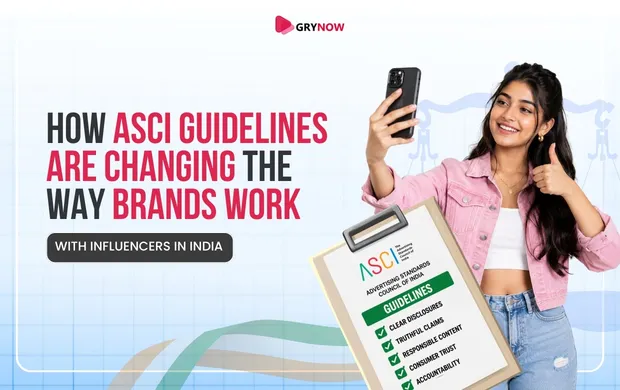
Not too long ago, if a creator posted about a product, you had no way of knowing whether they genuinely loved it or were paid to say so. Brands were quietly paying influencers, sending free products, and running full promotional campaigns, all without a single word of disclosure. Audiences trusted what they saw, and that trust was being taken advantage of.
It was not a small problem. India's influencer marketing industry had grown into a multi-thousand-crore ecosystem almost overnight, and the rules simply had not kept up. Creators were selling everything from supplements to financial products with zero accountability, and brands were happy to let it slide because the content was working.
That is exactly what made it dangerous.
The Advertising Standards Council of India ASCI saw where this was heading.
As India's self-regulatory advertising body, ASCI stepped in and released its Guidelines for Influencer Advertising in Digital Media, setting clear rules around what needs to be disclosed, how it needs to appear, and who is responsible when it does not. And with the Consumer Protection Act (CCPA) now backing these guidelines with real legal teeth, this is no longer a voluntary framework brands can choose to ignore.
Since these guidelines came into effect, the way brands and creators work together has fundamentally changed from how campaigns are briefed to how content is approved before it ever goes live.
This blog breaks down what ASCI actually requires, the mistakes brands are still making, and what full compliance looks like in practice.
What the ASCI Guidelines Actually Say
India's influencer marketing industry was valued at ₹3,600 crore in 2024 and is estimated to be worth ₹3,000–₹3,500 crore in 2025, with the sector projected to reach ₹4,500–₹5,000 crore by 2027, growing at a CAGR of 22% (Kofluence Report 2026). With that kind of scale, the stakes of getting this wrong are significant. With that kind of scale, the stakes of getting this wrong are significant. ASCI's guidelines exist to make sure that audiences, many of whom are making real purchase decisions based on creator content, can always tell the difference between a genuine recommendation and a paid one. Here is what the framework actually requires.
Disclosure Is Required for Every Material Connection
The starting point is understanding what triggers a disclosure requirement. ASCI uses the term "material connection," and it covers more than just a direct payment. Cash fees, free products, gifted experiences, barter arrangements, affiliate deals, discounts, and even early access given in exchange for content all count. If a brand has given a creator anything of value in connection with content about that brand, disclosure is not optional.
This matters more than most brands realize. In ASCI's 2024 dipstick study of India's top 100 digital influencers, 76% failed to properly disclose paid collaborations. ASCI REPORT Behind every one of those non-compliant posts is a brand that is equally exposed.
The Labels That Are Actually Accepted
ASCI is specific about which disclosure terms work and which do not. Accepted labels include advertisement, ad, sponsored, collaboration, partnership, employee, free gift, and affiliate. That is the full list of what qualifies.
What does not qualify: vague phrases like "thanks to [brand] for this," "sp," or "collab" buried in a caption. And here is something many brands get wrong: Instagram's native "Paid Partnership" tag is not sufficient on its own. The disclosure must also appear in the content itself, visible without any extra clicks or scrolling.
Where the Disclosure Has to Appear
Getting the label right is only half of it. Where the disclosure appears matters just as much, and the rules differ by content format.
For captions and text posts, the disclosure must appear at the very beginning before any "Read more" truncation kicks in. If someone has to tap to expand the caption before they see the disclosure, it does not count.
For images and static posts, the label needs to be superimposed directly on the image itself, clearly visible to anyone scrolling past.
For video content, the timing requirements are precise. Videos up to 15 seconds must display the disclosure for at least 3 seconds. Videos between 15 seconds and 2 minutes must show it for at least one-third of the total duration. For anything longer than 2 minutes, the disclosure must remain on screen for the entire section in which the brand or product is being discussed.
For Instagram Stories, the disclosure must be superimposed on the Story itself. The 24-hour expiry does not change the requirement; if it is promotional content, it needs a label.
For live streams, the creator must verbally announce the commercial nature of the content at both the beginning and the end of the broadcast.
What Counts as Non-Compliant
ASCI is clear about what falls short. Disclosures buried at the bottom of a caption inside a long line of hashtags do not meet the standard. Neither does any wording that an average consumer would have to think about to interpret as a commercial endorsement. The test is simple: if a normal person scrolling their feed would not immediately recognize the content as an ad, the disclosure has not done its job.
Celebrities and Virtual Influencers
Celebrities are not exempt. Verified accounts and large follower counts do not change the disclosure obligation; the same rules apply whether you have 10,000 followers or 10 million. High-profile violations by well-known names in India have already triggered public backlash and immediate post edits, which is not a position any brand wants to be associated with.
For virtual influencers, AI-generated personas with real social media followings, ASCI adds a separate requirement on top of standard commercial disclosure. Content must clearly state that the audience is not interacting with a real human being.
Health and Finance: An Additional Layer
In 2025, ASCI introduced Addendum 2, specifically targeting creators operating in health, nutrition, and BFSI, which is banking, financial services, and insurance. If a creator is providing specific technical advice in these categories, such as recommending supplements, commenting on medical conditions, or discussing investment strategies, they are now required to hold and disclose relevant qualifications or certifications. Broad lifestyle promotions are not affected, but the moment content moves into expert advice territory, the higher standard applies.
The reason this addendum exists is not hard to understand. Over 70% of influencer content flagged by ASCI in 2022–23 contained unsubstantiated or exaggerated claims. CPL
In categories where misinformation can directly harm someone's health or finances, that's not a compliance issue; it is a public safety one.
How does Grynow ensure full ASCI compliance?
Grynow has been running influencer campaigns in India for over 10+ years, with 3,500+ campaigns executed for brands including Amazon, Sony, Coca-Cola, Puma, Meta, and Google India. Over that time, one thing has become clear: compliance failures rarely happen because someone decided to break the rules. They happen because compliance was never built into the process in the first place.
That is the problem Grynow solves, not at the end of a campaign but from the very first step.
It Starts With The Brief.
Most agencies send a creative brief and follow up on content quality. Grynow's briefs include ASCI disclosure requirements as a non-negotiable part of the instructions, the correct label, where it needs to appear based on the content format, and the platform-specific rules that apply. Creators are not discovering compliance requirements after they have already shot the content. They know exactly what is expected before they start.
Contracts That Put Disclosure in Writing
A verbal briefing is not enough, and Grynow does not rely on one. Creator agreements explicitly include ASCI disclosure requirements as contractual obligations. If a creator posts non-compliant content, it is a breach of contract, and Grynow's team acts on it immediately. This also gives brands something valuable beyond just protection: a documented paper trail showing that disclosure standards were built into the campaign from day one.
Every Piece of Content Is Reviewed Before It Goes Live
This is where many agencies leave brands exposed. Grynow reviews every piece of content before it is posted, checking that the disclosure label is present and correctly placed, and prominent enough for the specific format. A Reel with the disclosure in tiny text at the bottom does not pass. A YouTube video that only mentions the partnership verbally without an on-screen label does not pass. Content gets cleared when it meets the standard, not before.
Creators Are Educated, Not Just Instructed
One of the most consistent compliance gaps in the market is creator confusion about platform-specific rules. A creator who correctly handles disclosure on a feed post may have no idea that stories require an on-screen superimposed label or that live streams need verbal announcements at both the start and end. Grynow addresses this directly by educating creators on the specific rules for each platform as part of every campaign onboarding. Compliance gets understood, not just assumed.
The Risk Is Real and It Sits with Brands Too
ASCI processed 1,409 influencer violations through November 2025, with 94% of them involving disclosure failures. What many brands do not realize is that the CCPA's enforcement powers extend to them, not just to the creator. A brand whose influencer campaign contains non-compliant content can face financial penalties, even if the creator was the one who posted it. The responsibility is shared.
With 3,500+ brand campaigns delivered and a compliance process that has been refined over the years across every major category like gaming, fintech, beauty, FMCG, and tech, Grynow's systems are built to protect brands from this risk, not just optimize their reach.
Common Mistakes Brands Still Make
Even with clear guidelines in place, the same influencer marketing mistakes keep showing up across campaigns. Here are the ones that matter most.
Asking creators to disclose only in the comments. It does not count. Disclosure has to appear in the primary content like the caption, the video, or directly on the image. A pinned comment does not satisfy the requirement, no matter how prominent it is.
Using "gifted" instead of "ad." Sending a product in exchange for content is a material connection. The right label is "Ad" or "Sponsored," not "gifted by" or "thanks to [brand] for sending this." Those phrases do not communicate to a consumer that they are looking at a paid promotion, which is exactly what ASCI requires them to understand.
Skipping disclosure on Stories. The 24-hour disappearing window does not create a compliance exception. If a story is promotional, it needs a visible on-screen label. That's the rule.
Assuming micro-influencers do not need to comply. There is no follower threshold below which the ASCI guidelines stop applying. A nano-influencer with 64,000 followers who received a free moisturizer is subject to exactly the same rules as a celebrity with 5 million. Brands are responsible for ensuring compliance at every tier.
Not having a written contract. Without a written agreement that includes disclosure as a condition of the collaboration, brands have no documented evidence of due diligence if a violation is flagged. A WhatsApp briefing is not a contract.
Running health or finance content without substantiated claims. Any specific efficacy claim like guaranteed results, fixed timelines, or projected returns must be backed by evidence. If the brand cannot support the claim with scientific or regulatory documentation, it cannot appear in the content.
Conclusion
ASCI guidelines are not a burden on influencer marketing in India; instead, they are making it better. Brands that embrace transparency are building more genuine relationships with their audiences, and creators who disclose honestly are building more long-term trust than those who hide paid partnerships. In a market growing as fast as India's creator economy, compliance is not just a legal requirement; it is a competitive advantage.
For brands that want to run campaigns that are both effective and fully compliant, partnering with an experienced agency like Grynow makes all the difference.