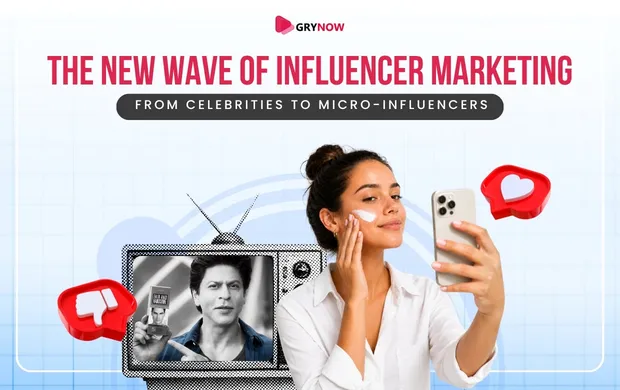
Picture this. It is 2008. You are watching cricket on a Saturday afternoon, and between overs, Shah Rukh Khan appears on your screen perfectly lit, holding a bottle of fairness cream, smiling directly at you. A billboard of the same image is plastered outside your local mall. Your mother sees it. Your neighbor sees it. Everyone sees it. And somehow, despite knowing it is an ad, people buy the product. Because if SRK uses it, it must be worth something. Right?
Now fast-forward to today. A 22-year-old girl from Jaipur posts a 90-second Instagram Reel while sitting in her bedroom. No professional lighting. No production crew. Just her, a ring light, and an honest opinion about a new skincare brand. Within 48 hours, the brand's website crashes because of the traffic. Her 80,000 followers are real people who have followed her journey for years and trusted her enough to act.
That is not a fluke. That is the new wave of influencer marketing. And the shift from Shah Rukh's billboard to that bedroom Reel did not happen overnight. Understanding why it happened and what it means for your brand in 2026 is what this article is about.
The Celebrity Advertising Era: When Face Value Was Everything
For decades, the formula was simple and almost unquestioned. Big brand + big face = big sales.
Celebrity-led marketing dominated Indian advertising for good reason. People aspired to look, live, and buy like their favorite stars. The logic was emotional rather than rational; if this person I admire uses this product, it must be desirable. Brands leaned into that psychology hard.
Yami Gautam endorsed Fair & Lovely (now Glow & Lovely), reassuring millions of Indian women that lighter skin was achievable with the right cream. Alia Bhatt fronted Maaza campaigns, her energy and relatability making the drink feel fresh and youthful. These were not bad marketing decisions at the time; they reflected how audiences consumed information: passively, through a handful of gatekept media channels.
But here is the thing about that era. Consumers were not really making informed decisions. They were making aspirational ones. They did not know the ingredients in the fairness cream. They did not know whether the celebrity actually used it. And they had no platform to ask. The communication was entirely one-directional, brand to consumer, with no feedback loop.
That was about to change.
The Rise of Micro-Influencers: How Ordinary People Built Extraordinary Trust
When Instagram launched in 2010 and YouTube was already a few years old, no brand executive sat in a boardroom and thought, "This is going to destroy the celebrity model."
But it did slowly, then suddenly.
What these platforms did was radical in the simplest possible way: they gave ordinary people an audience. A home cook in Pune could build 60,000 followers who genuinely cared about her recipes. A traveler from Bengaluru could document his trips to the Northeast and attract 45,000 people who planned their own holidays based on his videos. A skincare enthusiast in Delhi could talk about her acne journey and become the most trusted voice in her niche.
The first wave of Indian influencers' beauty, food, travel, and comedy proved something the advertising industry had underestimated: people trust people who look and sound like them far more than they trust people on billboards.
And social media changed consumer awareness dramatically. Suddenly, people could read ingredient labels, watch review videos, compare products in comment sections, and call out brands for misleading claims. Audiences became educated, and they started demanding content that was authentic and real, not polished and paid-for.
According to research, micro-influencers on Instagram achieve an average engagement rate of 3.86%, compared to just 1.21% for mega-influencers (Sociallyin, 2025). On a per-post basis, working with 10 micro-influencers at the same budget as one macro-influencer typically delivers 5 to 8 times more total engagement (OwlClaw Digital, 2026).
The Influence of Micro-Influencers: Why Niche Beats Famous
What makes micro-influencers in India genuinely powerful is not just their engagement rate; it is how they built their audience.
They did not wake up famous. They spent months, sometimes years, creating content in a specific niche, showing up consistently, responding to comments, and building real relationships with real people. Their followers are not passive scrollers; they are an invested community. And because of that, when a micro-influencer includes a product naturally in their daily life, it does not feel like an ad. It feels like a recommendation from a friend who happens to know a lot about the subject.
That is not a small thing. That is the most powerful form of marketing that exists.
One campaign for a sustainable fashion brand saw cost-per-acquisition drop by 40% after switching from one celebrity to 30 micro-influencers (Pearson Hardmann, 2025). The celebrity generated awareness; the micro-influencers generated conversions. The difference was simple: trust converts; reach alone does not.
So working with micro-influencers and celebrities does not mean your campaign will create buzz around your audience and achieve desired results.
As per the research, 73% influencer campaigns fail to achieve their brand's objectives.
This is precisely where Grynow, a top influencer marketing agency in India enters the picture. With a vetted network of thousands of micro and mid-tier creators across India and 10 years of experience running campaigns for 1500+ brands, Grynow has been working with this insight long before it became an industry consensus. They do not just connect brands with influencers; they match brands with the right creators, based on data, niche alignment, audience authenticity, and campaign objectives. No follower count.
The Best Strategy for Brands in 2026
Here is a belief that holds a lot of brands back: the idea that you have to choose between celebrities and micro-influencers. The smartest brands in 2026 are not making that choice. They are using both strategically, at different stages of the funnel.
When to use a celebrity: Large product launches that need mass awareness fast. Brand repositioning campaigns where cultural association matters. Categories where aspiration is still a core purchase driver: luxury, premium fashion, and high-end consumer tech.
When to use micro-influencers: Niche targeting with high purchase intent. Trust-building in categories where authenticity matters: health, finance, EdTech, SaaS tools. Conversion-focused campaigns where cost-per-acquisition needs to be defensible.
A celebrity builds curiosity. Local creators build credibility. Together, they maximize ROI at every stage of the funnel.
Looking ahead, the next frontier is already here: nano-influencers, regional creators producing content in local languages, and AI-driven creator matching that takes the guesswork out of finding the right fit. Influencers producing content in Tamil, Telugu, Marathi, Bengali, and Kannada are seeing engagement rates that put their Hindi-language counterparts to shame (Agency Reporter, 2026) and most brands have not caught up to that reality yet.
Conclusion
The evolution from celebrities to micro-influencers is not about Shah Rukh Khan becoming irrelevant. It is about brands finally having a full toolkit. Celebrities reach the top. Micro-influencer trust in the middle. Nano-creator community at the bottom. Used well, these are not competing strategies; they are complementary layers of a high-performing campaign.
The brands winning in 2026 are the ones who understand when to use each tier and how to measure what matters. And the ones building those campaigns most effectively are partnering with agencies like Grynow who bring a decade of experience, 3500+ campaigns executed successfully, and a 1.5M vetted creator network that removes the guesswork entirely.
The question is no longer whether influencer marketing works. The question is, is your brand using it strategically enough to stay ahead?