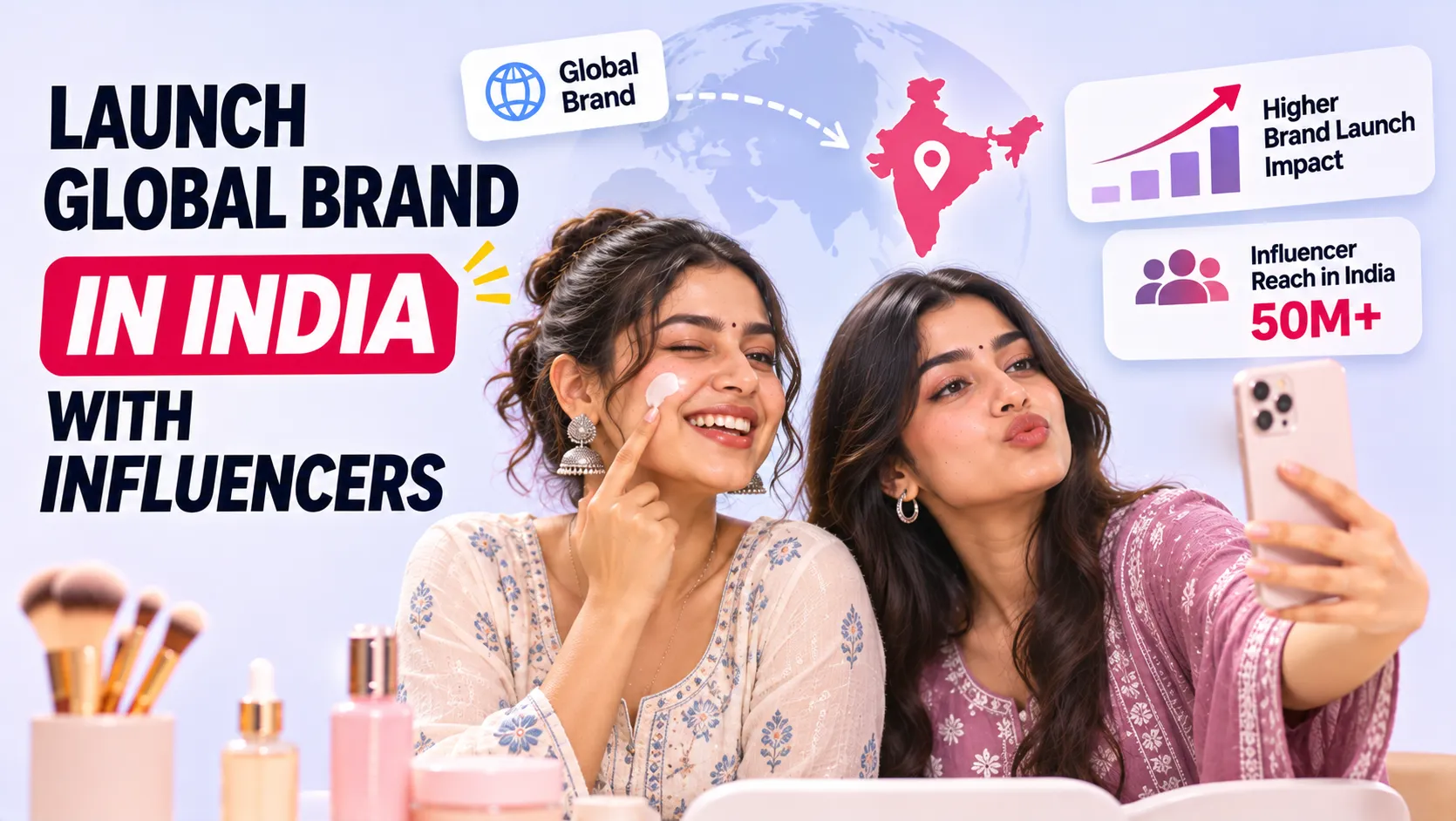
Most international brands that stumble in India do not fail for lack of budget. They fail because they treat India as one market and ship their global campaign with a Hindi subtitle. A skincare brand that works in London or a fragrance brand that sells in Dubai can still go unnoticed in Mumbai, Hyderabad and Lucknow if the people introducing it are the wrong people.
The practical way to launch a brand in India with influencers is to run a structured 90-day programme: 30 days of research and creator selection, 30 days of market introduction through vetted Indian creators, and 30 days of measuring, cutting what does not work and scaling what does. That sequence matters more than any single celebrity post, because India rewards brands that earn trust city by city and language by language.
The opportunity is real. EY estimated India's influencer marketing industry would reach INR 3,375 crore by 2026 (EY India, 2024), and newer platform data from Kofluence puts 2026 spend at INR 4,500–5,000 crore (Kofluence, 2026). The same research shows the growth sits outside the metros, in vernacular content and short-form video, which is exactly where most global playbooks have no answer.
Why International Brands Need an Influencer-Led India Launch Strategy
International brands need an influencer-led launch because Indian consumers meet unfamiliar brands through people they already trust, and those people differ by region, language and category. A creator in Kochi speaking Malayalam about sunscreen reaches a different buyer than a Delhi lifestyle creator posting in Hinglish, and both reach buyers a global brand ad will not.
India is many markets, not one. Kofluence's 2026 research found Tier 3 and Tier 4 cities now account for 43–48% of influencer campaigns, with engagement of 4.5–5.5% against 3–4% in metros. It also found 68.2% of surveyed creators work mainly in Hindi and 23.9% in regional languages (Apparel Resources, May 2026). An India market entry strategy that only covers English-speaking metro audiences is planning for a minority of the opportunity, which is why regional and vernacular creators belong in the plan from day one.
Local creators lend credibility you cannot buy with media. A new foreign brand has no reviews, no word of mouth and often no shelf presence. Creators fill that gap: they show the product in an Indian home, compare it with brands the audience already knows, and answer the questions buyers actually ask, such as price in rupees, where to buy, and whether it suits Indian skin, weather or cooking.
Niche and regional creators do the explaining. Mega creators create a moment; niche creators explain why the product matters. EY's research found nano influencers had the highest engagement of any tier, and 47% of brands preferred micro and nano creators for lower cost per reach (EY India, 2024). The same shift explains why regional influencers are outperforming pan-India creators in many categories.
Market entry vs. running an influencer campaign
| Running an influencer campaign | Entering the Indian market with influencers | |
|---|---|---|
| Goal | Reach and engagement for a known brand | Awareness, trust and first purchases for an unknown brand |
| Audience | Existing followers and lookalikes | New cities, languages and buyer segments to be tested |
| Messaging | Adapted from a global brief | Rebuilt around Indian pricing, use cases and objections |
| Creator mix | A few creators who fit the brand | A tested portfolio across tiers, regions and categories |
| Output | Posts and a report | Market learning, proven creators and reusable UGC for the next phase |
| Timeframe | One flight, often 2–4 weeks | A staged programme, typically 90 days, then always-on |
The second column is what this playbook covers.
The 90-Day Playbook to Launch a Brand in India with Influencers
The playbook splits the launch into three 30-day phases, each with a clear exit test. You only move to the next phase when the previous one has produced its deliverable, not when the calendar says so.
| Phase | Days | Core question | Exit deliverable |
|---|---|---|---|
| 1. Research and creator discovery | 1–30 | Who are we for in India, and who should introduce us? | Positioning brief, priority markets, vetted creator shortlist |
| 2. Campaign planning and market introduction | 31–60 | Can creators make Indian buyers understand and want this product? | Live content across 2–3 creator cohorts, first performance data |
| 3. Scaling and optimisation | 61–90 | What works, and where do we double down? | Scaled winners, UGC library, plan for the next quarter |
Phase 1: Days 1–30 — Research, Positioning and Creator Discovery
The first 30 days decide whether the launch spends money on the right people. Skip this phase and you will spend the next 60 days paying for reach that does not convert.
- Define the Indian target customer. Age, income, city tier, language and where they buy (quick commerce, marketplaces such as Amazon, Flipkart or Nykaa, or offline retail). A premium skincare brand and a mid-priced electronics brand will land on very different profiles.
- Pick two to four priority markets. For example, Mumbai and Bengaluru for an English-first premium product, or Delhi NCR plus Lucknow and Jaipur for a Hindi-belt mass launch. Add a southern state with its own language creators if distribution covers it.
- Study the category and competitors. Which domestic and international brands already own the category, what they charge, which creators they use and what objections show up in comment sections. Our India influencer marketing benchmark report for international brands is a useful starting point.
- Adapt positioning for India. Translate the value proposition into Indian price points, use cases and proof. "Clinically tested" means more when a creator explains it for humid weather or hard water.
- Choose creator categories. Map product to content verticals: beauty and skincare, tech reviewers, food, parenting, finance, fitness or lifestyle.
- Decide the tier mix. Use macro or mega creators for reach moments, micro and nano creators for trust and conversation (see the tier table below).
- Vet audiences, not follower counts. Check audience city and language split, engagement quality, comment authenticity, past brand deals and any competitor conflicts.
- Build the shortlist. Typically two to three times as many creators as you plan to contract, with backups in each tier.
What to expect from your Indian influencer marketing agency in Phase 1: a written audience and market brief, a category scan of competitor creator activity, a tiered creator shortlist with audience data for each name, indicative cost ranges per tier, and a recommended platform mix. If an agency jumps straight to a list of famous names without audience data, treat that as a warning sign.
Phase 2: Days 31–60 — Campaign Planning and Market Introduction
Phase 2 turns research into content that introduces the brand to Indian consumers for the first time. The aim is familiarity and understanding, not yet maximum scale.
- Campaign concept. One clear idea that works across languages, for example, "first impressions", a 14-day trial, a festive gifting angle, or a side-by-side with a product buyers already know.
- Outreach and onboarding. Contracts that set deliverables, timelines, usage rights, exclusivity windows and disclosure requirements.
- Creator briefs. Key messages, mandatory claims, things never to say, and freedom for the creator to explain the product in their own voice. Over-scripted content reads as an ad and underperforms.
- Language and cultural adaptation. Briefs translated and localised, not literal. Watch festival timing (Diwali, Eid, Onam, Durga Puja), regional sensibilities and claims that need substantiation.
- Product seeding and sampling. Send product to a wider pool of nano and micro creators before paid content goes live, so early organic reviews exist when people search the brand.
- Paid and barter collaborations. Barter influencer collaborations (product in exchange for content) suit nano creators and early seeding; paid deals suit macro creators and anything with fixed deliverables.
- Platforms. Instagram Reels and YouTube (long-form reviews plus Shorts) for most consumer launches; LinkedIn for B2B; Snapchat, Moj or Josh only where the audience data supports it.
- UGC production. Commission user-generated video creators in parallel to produce ad-ready videos that are owned for paid use, separate from influencer posts.
- Approvals and publishing schedule. A shared calendar, a 24–48 hour approval window, and every post checked for disclosure under the ASCI influencer marketing guidelines in India, which require a clear label such as #ad or #collab on promotional posts.
A useful pattern for introducing an unknown brand is the three-beat sequence: a teaser or pre-launch post, a launch or experience post, and a review or results post per creator. It gives the audience three exposures and lets you compare which beat drives clicks and searches.
Phase 3: Days 61–90 — Scaling and Performance Optimisation
Phase 3 moves the brand from "seen it" to "considering it". You keep what worked, cut what did not and turn the best content into paid media.
- Analyse performance by creator, city and format. Reach, impressions, views, engagement rate, saves and shares, link clicks, promo code redemptions and branded search lift. This is where you measure influencer marketing ROI rather than vanity reach.
- Score each creator. Cost per view and cost per engagement against the cohort average, comment quality, and whether their audience matched the brief.
- Identify winning content. Hooks, formats, languages and angles that outperformed.
- Scale successful partnerships. Move top creators to multi-post or monthly deals, and add lookalike creators in the same city or niche.
- Amplify with paid media. Run the best creator posts as partnership ads on Instagram, or as YouTube ads, with the creator's permission and the right usage rights.
- Build a UGC library. Organise owned videos by product, language and hook for performance marketing over the next two quarters.
- Plan the next cycle. Set quarter-two targets, add new regions or languages, and align with the festive calendar.
By day 90, the brand should have a proven creator roster, clear evidence of which Indian audiences respond, and a content library that keeps working after the launch flight ends.
KPIs to track across the 90 days
| Phase | Primary KPIs | Secondary signals |
|---|---|---|
| Days 1–30 | Shortlist quality: audience match %, engagement authenticity | Category share of voice baseline, competitor creator spend |
| Days 31–60 | Reach, views, engagement rate, content delivered on time | Comment sentiment, branded search, seeding post-rate |
| Days 61–90 | Cost per view or engagement, clicks, code redemptions, sales | Repeat creator performance, paid amplification ROAS, UGC assets produced |
How to Choose the Right Indian Influencers for Your Brand
The right Indian influencers for an international brand are the ones whose audience matches your target buyer by city, language and intent, and whose content style makes your product easy to understand. Follower count tells you potential reach; it does not tell you whether the right people are watching.
Use these nine checks for every creator on the shortlist:
| Check | What to look at | Red flag |
|---|---|---|
| Audience relevance | Interests, age and gender split against your buyer profile | Audience mostly outside India, or outside your category |
| Regional and language fit | Top cities and the language of comments, not only captions | A "Chennai creator" whose engagement comes mostly from elsewhere |
| Credibility | Does the creator explain, test and compare, or only showcase? | Every post is sponsored, with no organic content in between |
| Engagement quality | Real comments, questions, saves and shares | High likes with generic or repeated comments |
| Content quality | Lighting, audio, storytelling, consistency | Polished visuals with no clear point of view |
| Past collaborations | Brands worked with in the last 6–12 months | A direct competitor in the last 90 days |
| Platform suitability | Reels for discovery, YouTube for considered purchases | Strong on one platform but contracted for another |
| Audience demographics | Verified insights shared by the creator or an analytics tool | Unwilling to share audience data |
| Tier fit | Role in the campaign: reach, trust or conversion | Choosing a tier because of fame, not campaign role |
Influencer tiers compared
Follower bands below are common industry definitions; agencies and platforms draw the lines slightly differently.
| Tier | Typical followers | Best campaign role | Strengths | Trade-offs |
|---|---|---|---|---|
| Nano | 1K–10K | Seeding, local word of mouth, early reviews | Highest engagement in EY's research; close community trust; often open to barter | Small reach each; many creators to manage |
| Micro | 10K–100K | Niche trust, regional depth, conversion | Strong niche credibility; efficient cost per engagement | Needs volume to move awareness |
| Macro | 100K–1M | Category reach, launch moments, YouTube reviews | Professional content; meaningful reach in one post | Higher fees; engagement rates usually lower |
| Mega / celebrity | 1M+ | Big-bang awareness, PR value | Instant visibility and press pickup | Highest cost; weaker per-rupee engagement; less detailed product explanation |
Most successful India launches combine tiers rather than pick one: a few macro or celebrity creators to create the moment, a larger layer of micro influencers to explain the product in each priority region, and a broad base of nano influencers to make the brand look already talked about.
Which Influencer Marketing Platforms Should International Brands Prioritise in India?
For most consumer brands launching in India, prioritise Instagram (especially Reels) and YouTube (long-form reviews plus Shorts). Use LinkedIn for B2B and professional audiences. Do not plan TikTok content for India: the app has been blocked there since June 2020.
EY's research named Instagram and YouTube as the most preferred platforms for consuming influencer content in India (EY India, 2024). Kofluence's 2026 creator survey found 84.5% of creators named short-form video as their highest-earning format, and 77.6% were not active on any Indian short-video app (Apparel Resources, May 2026).
A note on TikTok. India banned TikTok and 58 other Chinese apps in June 2020 under Section 69A of the IT Act. The government and TikTok both confirmed in 2025 that the ban remains in force, and the app is not available on Indian app stores (Storyboard18; TechCrunch). If TikTok is your main channel in the US, UK or Gulf markets, move that budget and creative thinking to Instagram Reels and YouTube Shorts for India.
| Platform | Status in India | Best for | Typical launch use |
|---|---|---|---|
| Available | Beauty, fashion, food, lifestyle, D2C, regional reach | Reels for discovery, Stories for links and codes, partnership ads for amplification | |
| YouTube | Available | Tech, auto, finance, considered purchases, Hindi and regional audiences | Long-form reviews and unboxings; Shorts for reach |
| Available | B2B, SaaS, fintech, hiring and employer brand | Thought-leader posts and launch announcements | |
| Snapchat | Available | Younger audiences in some cities | Supporting channel, test before scaling |
| Moj, Josh and other Indian short-video apps | Available | Mass-market, Tier 2–4 reach | Test only where audience data supports it |
| TikTok | Blocked since June 2020 | Not applicable | Reallocate to Reels and Shorts |
How category changes the mix:
- Beauty and personal care: Led by Instagram influencer campaigns, with YouTube tutorials and long reviews for higher-priced products.
- Consumer tech and electronics: Led by YouTube influencer marketing; Indian buyers watch detailed reviews before purchase. Instagram supports launch-day reach.
- Food and beverage: Instagram Reels with food and home creators, plus regional language creators per market.
- Fintech and finance apps: YouTube and Instagram finance creators, with extra care on regulatory claims.
- B2B and SaaS: LinkedIn influencer campaigns and YouTube explainers.
How Much Should International Brands Budget for Influencer Marketing in India?
There is no single price for an influencer campaign in India; cost depends on creator tier, number of creators, formats, platform, usage rights and how much paid amplification you add. The most reliable way to set a budget is to fix the outcome you need in each 30-day phase, then price the creator mix that can deliver it.
Published benchmarks give a rough sense of scale. Kofluence's 2026 report puts average campaign costs at about INR 35,000–90,000 (roughly US$360–930) in Tier 3 and 4 cities, against INR 3.8–4.5 lakh (roughly US$3,900–4,700) in metro markets, and typical creator-led e-commerce campaigns at INR 8–14 lakh (roughly US$8,300–14,500) (Apparel Resources, May 2026).
Read these numbers with care. They are averages from one platform's data, they mix very different campaign sizes, and they do not include production, usage rights or paid media. A multi-city launch with macro creators, YouTube reviews and paid amplification will cost a multiple of these figures. Treat them as orientation, not a quote.
What drives the cost
| Cost factor | Why it changes the price |
|---|---|
| Creator tier | Fees rise sharply from nano to mega; nano creators may accept product (barter) |
| Number of creators | More creators cost more but spread risk and cover more regions |
| Content format | A YouTube integration or dedicated review costs more than a Reel or Story |
| Platform | YouTube long-form usually costs more per creator than Instagram |
| Usage rights | Using creator content in your own ads adds a fee, priced by duration and channels |
| Exclusivity | Blocking a creator from working with competitors for months costs extra |
| Paid amplification | Media spend behind creator posts is separate from creator fees |
| Campaign duration | Always-on deals cost more in total but less per post |
| Production | Travel, shoots, store visits, events and product shipping |
A sensible way to split a 90-day budget
Rather than a fixed formula, use the phases to protect your spend:
- Days 1–30: a small share on research, seeding and product shipping. Little or no paid creator spend yet.
- Days 31–60: the largest creator spend, spread across tiers and regions so you can compare results.
- Days 61–90: move money from underperformers to proven creators and paid amplification of the best posts.
For a launch-ready estimate based on your category, cities and goals, ask your agency for an itemised plan that separates creator fees, usage rights, production, paid media and management fees.
Common Mistakes International Brands Make When Launching in India
Most failed India launches repeat the same eight mistakes. Each one has a simple fix.
| Mistake | What it looks like | Fix |
|---|---|---|
| Global messaging, no local adaptation | The UK hero video with Hindi subtitles | Rebuild the message around Indian price, use cases and objections |
| Picking creators by followers | One celebrity post, high views, no sales | Vet audience city, language and engagement quality first |
| Ignoring regional creators | Only Mumbai and Delhi English-language creators | Add Hindi and regional language creators in priority states |
| Underestimating cultural differences | Off-tone humour, wrong festival timing, unsuitable imagery | Local review of every brief and script |
| Wrong platforms | Planning TikTok, or Instagram-only for a tech product | Match platform to category and purchase journey |
| No KPIs | "Let's see what happens" | Set phase-level KPIs before any contract is signed |
| No execution partner | Head office emailing dozens of creators across time zones | Use a local team or agency for outreach, contracts and approvals |
| No performance review | One report at the end, no changes mid-flight | Weekly reporting in Phase 2, reallocation in Phase 3 |
Two of these deserve extra attention. First, disclosure: under India's ASCI guidelines, promotional creator posts must carry a clear, upfront label, and the advertiser shares responsibility when there is a material connection with the creator. Second, claims: health, beauty and finance claims that are acceptable in your home market may need different evidence or wording in India.
Why Work with an Influencer Marketing Agency in India?
International brands usually work with an experienced influencer marketing agency in India because a launch involves dozens to hundreds of creator relationships, in several languages, on Indian working hours, with negotiation norms and compliance rules that a head office team cannot manage well from London, New York or Dubai. EY's survey found 77% of brands consider their agencies fairly equipped to run influencer campaigns (EY India, 2024).
| What a local agency handles | Why it matters for a foreign brand |
|---|---|
| Access to relevant Indian creators | Existing relationships across tiers, regions and languages shorten Phase 1 |
| Creator discovery and vetting | Audience checks and fake-engagement screening before money is committed |
| Regional market knowledge | Which cities, languages and festivals matter for your category |
| Strategy and execution | One plan across Instagram, YouTube and LinkedIn instead of separate experiments |
| Negotiation and coordination | Fair rates in rupees, clear contracts, usage rights and backup creators |
| Content management | Briefs, localisation, approvals and disclosure checks |
| Monitoring and reporting | Weekly data in Phase 2 and clear reallocation decisions in Phase 3 |
| Scale | Moving from 20 creators to 200 without adding headcount at home |
Where Grynow fits
Grynow is an influencer marketing agency headquartered in Gurugram, with an office in Dubai, that plans and runs creator campaigns across India and international markets. It works as a product launch agency in India for global brands introducing new products or entering the market for the first time. They have a professional team that has executed more than 4,200 influencer campaigns over 12+ years and runs paid, barter, affiliate and UGC campaigns across Instagram, YouTube, LinkedIn, Snapchat, Facebook and X. Creator vetting and reporting run through its own AI-supported dashboard, which screens for mismatched follower and engagement patterns.
Grynow has executed influencer-led launches for international brands entering or growing in India, including these campaigns:
| Brand | Origin | Campaign | Creators and content | Results |
|---|---|---|---|---|
| TECNO POVA Curve 2 | Global smartphone brand | Mass-scale India product launch on Instagram and YouTube Shorts, focused on tech-niche micro and mid-tier creators | 440 creators posting during the launch window | 20.7M total views, 175.52K total engagements |
| Beauty of Joseon | South Korea | Footfall and buzz for the brand's stall at Nykaaland | Niche beauty, skincare and lifestyle creators, each posting a pre-buzz, event and review reel | 90 reels, 15.2M average views |
| Sheikh Saeed | UAE | Market entry: introducing the fragrance and deodorant range to Indian consumers | 7 creator videos across 2 campaigns | 2.9M views |
| Ajmal Perfumes | UAE | Awareness and footfall for its flagship store launch in Hyderabad | 18 micro, macro and mega creators in entertainment, fashion and lifestyle | 1.9M views |
For brands entering India from the Gulf, the same team also runs campaigns in the UAE and Saudi Arabia, which helps when a brand wants consistent creator storytelling across both markets.
The pattern across these launches mirrors the 90-day playbook: a clear market-entry objective, creators chosen by niche and city rather than fame alone, and content sequenced so audiences see the brand more than once.
Turn Your India Market Entry into a Structured Influencer Campaign
To launch a brand in India with influencers, treat the first 90 days as a sequence, not a burst: research and vet creators first, introduce the brand through a tiered mix of regional and niche voices, then scale only what the data proves. Brands that follow that order spend less on reach that does not convert and finish the quarter with a creator roster and content library they can keep using.
If you are planning an India launch and want a local team to handle creator discovery, campaign planning and end-to-end execution, contact Grynow's influencer marketing team. Share your category, target cities and launch window, and the team can outline a 90-day creator plan with an itemised budget.