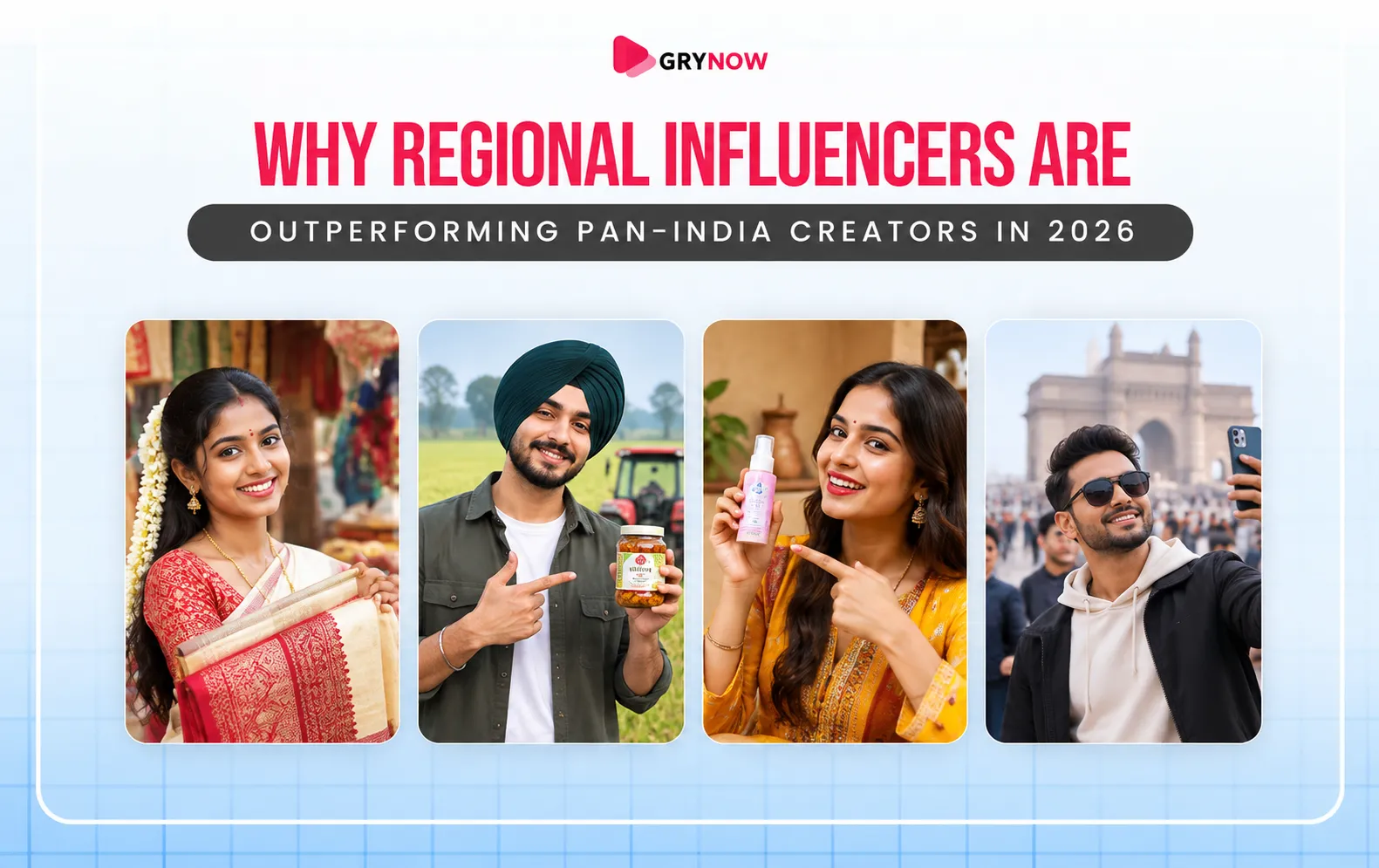
For years, brands in India followed a simple influencer marketing formula: go big, go pan-India, and work with English-speaking creators. In 2026, that approach is becoming less universal.
India's influencer marketing landscape is becoming increasingly regional, with brands paying more attention to creators who understand a specific language, culture, community, and local audience.
Today, the Indian influencer marketing industry is on track to cross ₹3,375 crore by the end of 2026, and the money is moving in a new direction towards regional and vernacular creators instead of metro-based, pan-India names.
The reason is simple: Indian audiences are highly diverse. Consumers in different regions do not necessarily respond to the same language, references, festivals, or content styles. For brands trying to reach audiences beyond major metros, a creator who speaks the audience's language and understands their everyday context can often create a stronger connection than a larger creator with a broad but less relevant audience.
A regional micro-creator with fifteen or twenty thousand followers in a Tier 3 city, producing content in the local language around locally relevant occasions, is increasingly outperforming a much larger metro creator on both engagement and cost efficiency.
That doesn't mean pan-India creators have become irrelevant. They remain valuable for campaigns focused on national reach, awareness, and large-scale launches. The difference is that brands are increasingly choosing creators based on audience relevance rather than follower count alone.
That is why brands and marketers are moving from briefs built around "creators in Mumbai" toward briefs focused on creators who genuinely understand and influence a particular language or region.
Why Regional Creators Are Winning: The Core Reasons
Language Builds Trust Faster Than Production Value
A highly produced video in English may look polished, but content delivered in a language that an audience naturally speaks and understands can feel more relatable.
Regional creators can communicate products, benefits, and recommendations using local expressions, cultural references, and conversational styles that may be difficult for a national campaign to replicate.
For brands targeting specific states or language communities, this makes regional creators particularly useful for building familiarity and trust.
Less Saturated Audiences
Regional-language creator ecosystems can give brands access to audiences that are less saturated with national advertising and influencer collaborations.
This can be especially relevant in Tier 2 and Tier 3 markets, where creators often have strong connections with local communities and niche audiences.
Instead of focusing only on how many people a creator can reach, brands can evaluate whether the creator reaches the right people in the right market.
Follower Size Isn't the Whole Story
A creator's follower count is only one part of campaign evaluation.
Nano and micro creators can have highly engaged communities because their content is often more focused and personal. A regional micro-creator may also have stronger audience relevance than a much larger creator whose followers are spread across multiple cities, languages, and interest groups.
For brands, the more useful question is not simply, "How many followers does this creator have?" but rather, "How relevant is this creator's audience to the people we want to reach?"
Conversion, Not Just Attention
Reach and impressions are useful for awareness, but many campaigns ultimately need to influence consideration or purchase.
When a regional creator recommends a product in a familiar language and context, the recommendation can feel more personal and relevant to the audience.
This can be particularly useful for categories such as FMCG, beauty, food, D2C, consumer products, and regional services where local familiarity can influence purchase decisions.
The result is a shift from measuring influencer campaigns only by visibility toward evaluating engagement, audience quality, clicks, conversions, and overall campaign efficiency.
How Regional Creators Actually Post
Regional creators aren't simply "influencers in another language." Their content is often shaped around how their particular audience consumes content, communicates, and responds to local references.
1. Short-Form Vertical Video Is the Core Format
Short-form vertical video remains one of the most important formats for creator marketing, particularly across Instagram Reels and YouTube Shorts.
The format works well for regional campaigns because creators can naturally incorporate local languages, expressions, humour, cultural references, and everyday situations into short videos.
For brands, this creates an opportunity to produce content that feels native to the platform rather than like a national advertisement translated into another language.
2. Lo-Fi Content Can Feel More Authentic
Regional influencer campaigns don't always need highly produced brand films.
Lightly produced, creator-led content such as product demonstrations, reviews, day-in-the-life videos, tutorials, and recommendations can feel more natural when the creator's personality remains visible.
The objective isn't necessarily to make the content look less professional. It is to make the product fit naturally into the creator's existing content style.
3. Occasion and Hyperlocal Relevance Matter
Regional creators can build campaigns around local festivals, cultural occasions, community events, dialects, and seasonal shopping behaviour.
This allows brands to move beyond simply translating a national campaign into another language.
For example, a campaign targeting audiences in Tamil Nadu may require a different cultural approach from one targeting audiences in Maharashtra, West Bengal, or Kerala, even when the underlying product is the same.
4. Language-First Briefing
Influencer briefs are increasingly moving beyond location-based targeting.
Instead of simply asking for "creators based in a particular city," brands can define requirements around language, audience location, content category, cultural relevance, and creator style.
The goal is to identify creators who genuinely own a language and community, rather than simply finding someone who happens to live in a particular region.
Real Example of a Regional Influencer Marketing Campaign
A strong example of regional influencer marketing is amante's AW25 festive campaign, which partnered with Grynow to connect its fashion and festive positioning with audiences across different Indian markets. The campaign worked with regional fashion influencers who interpreted festive dressing through their own cultural lens, covering occasions such as Durga Puja in Kolkata, Deepavali in Chennai and Bengaluru, Lakshmi Puja in Gujarat, and Dhanteras in Delhi.
Instead of using one standard festive message across India, the creators brought local perspectives to the campaign while keeping the brand's overall festive positioning consistent. This helped the content feel more relevant to audiences in different regions and demonstrated how regional creators can make a broader campaign feel locally connected.
The campaign delivered measurable results, generating 549K views, a 3.20% average engagement rate, and a 31% view-through rate. The campaign shows how combining regional creators with culturally relevant storytelling can help fashion brands build visibility across multiple markets while keeping their content locally relatable.
Cost Breakdown: What Regional Influencers Actually Charge
One of the biggest reasons brands consider regional creators is campaign efficiency.
Regional and Tier 2/3 creators can sometimes deliver strong engagement and audience relevance at a lower absolute cost than celebrity or large pan-India creators. However, influencer pricing varies significantly depending on creator size, platform, content format, audience quality, campaign duration, usage rights, and deliverables.
For a detailed breakdown of influencer pricing across creator categories, platforms, and campaign formats, see our influencer marketing cost in India guide.
This can help brands compare creator costs before deciding whether to allocate their budget to one large creator or a larger group of regional creators.
How Brands Can Build a Regional Influencer Strategy
Choosing regional creators isn't simply about dividing a campaign budget across different states. Brands should build their influencer marketing strategies around the audience they want to reach.
1. Start With the Target Market
Identify the states, cities, languages, and audience groups that matter most to the campaign.
2. Prioritize Audience Fit
Look beyond follower count and evaluate audience location, language, demographics, engagement quality, and content relevance.
3. Build Creator Clusters
Instead of depending on one creator, brands can work with multiple regional micro and mid-tier creators to build broader coverage within a specific market.
4. Adapt the Creative Brief
Give creators clear campaign objectives while allowing them enough freedom to communicate in their natural language and content style.
5. Measure Beyond Reach
Track metrics such as engagement rate, video views, clicks, coupon usage, conversions, and cost per engaged user to understand the campaign's real efficiency.
Practical Budgeting Tips
Distribute the budget across relevant regional creators: A creator cluster can reduce dependence on one large name and help brands reach multiple audience segments.
Consider creator series instead of one-off content: A 3–5-post collaboration can give audiences repeated exposure to a product and may provide better continuity than a single post.
Explore performance-linked models: Affiliate links, coupon codes, or commission-based incentives can help D2C and FMCG brands connect creator activity with measurable outcomes.
Compare cost per engaged audience: Don't evaluate creators only by their total fee. Compare the cost against relevant engagement, clicks, views, or conversions.
Conclusion
The growth of regional influencer marketing does not mean that pan-India creators are becoming irrelevant. Instead, it reflects a broader shift in how brands evaluate influencer partnerships.
Follower count and national reach are no longer the only factors brands need to consider. Language, audience location, cultural relevance, content style, engagement quality, and conversion potential can be equally important.
For brands targeting India's diverse consumer markets, regional creators can offer a way to make campaigns feel more local, relatable, and relevant.
The most effective strategy may therefore not be choosing between regional and pan-India creators, but understanding where each type of creator fits into the campaign.