Most influencer marketing in India starts in the metros. Brands build their first campaigns around Mumbai, Delhi, Bengaluru, or Hyderabad creators because that's where the influencer ecosystem is densest and easiest to access. But the moment a brand tries to scale that same playbook into Tier 2 and Tier 3 cities — Indore, Coimbatore, Jaipur, Guwahati, Kanpur — the returns often flatten out.
The reason isn't budget or creative quality. It's fit. A Mumbai-based lifestyle influencer speaking polished Hindi-English to a metro audience doesn't automatically carry the same trust or relatability in a smaller city where language, local references, and everyday context look different. Tier 2/3 audiences are not a smaller version of Tier 1 — they respond to different cues, and influencer marketing in India has matured enough that brands can no longer treat "national reach" as a proxy for "everywhere effectiveness."
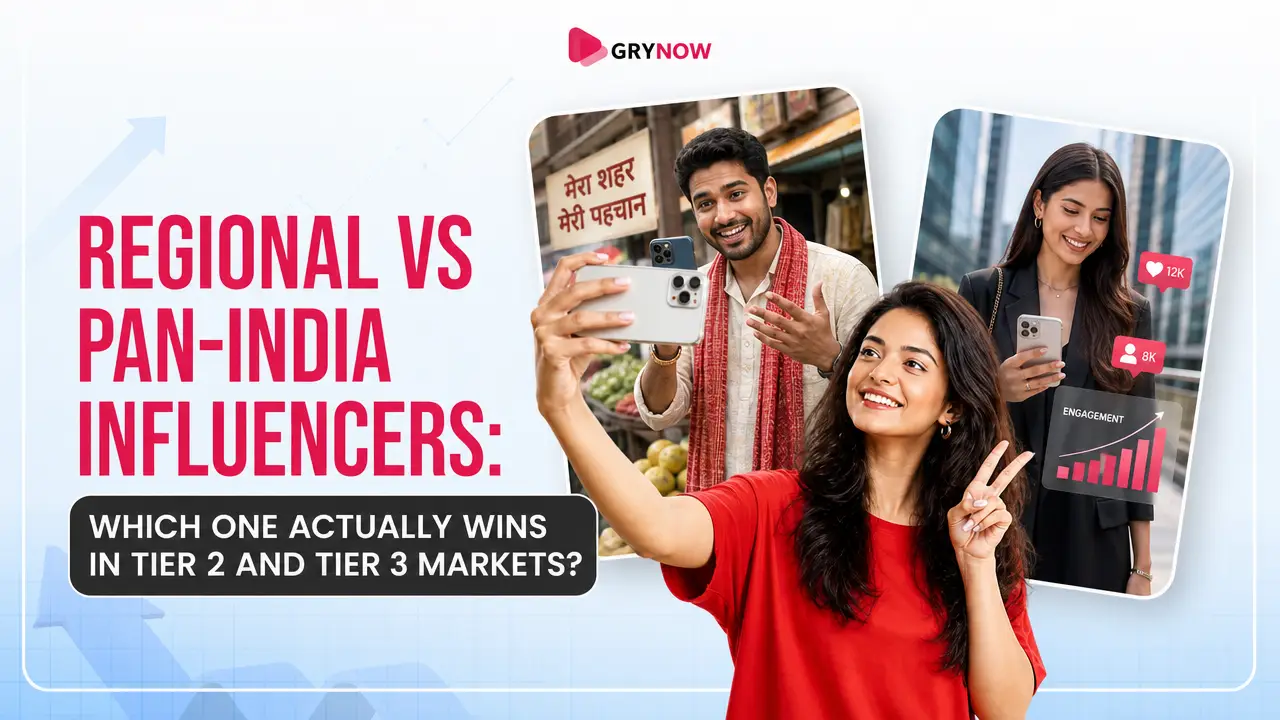
This is what turns regional influencer marketing India into a genuine strategic fork rather than a stylistic preference. Brands expanding into smaller cities have to actively decide: do we go deeper with local-language creators who understand the market from the inside, or do we lean on pan-India names whose reach and credibility already precede them? Getting this decision right — or wrong — has direct consequences for conversion rates, cost per acquisition, and how quickly a new market starts trusting the brand.
What 'Regional Influencer' and 'Pan-India Influencer' Actually Mean
Before comparing the two, it helps to define them precisely.
A regional influencer is a creator who builds and maintains an audience rooted in a specific city, state, or linguistic community — creating primarily in a local language (Tamil, Marathi, Bengali, Gujarati, Kannada, and so on) and referencing local culture, festivals, dialects, and civic context that resonate specifically with that audience. Their following is often smaller in absolute numbers but heavily concentrated and highly engaged within that geography.
A pan-India influencer, by contrast, is a creator with a nationally distributed audience, typically communicating in Hindi and/or English, based in a metro city, and covering themes broad enough to travel across states without losing relevance — fitness routines, finance basics, fashion trends, comedy, or lifestyle content that doesn't depend on local specificity.
The core differences come down to three things:
| Factor | Regional Influencer | Pan-India Influencer |
|---|---|---|
| Language | Local/vernacular-first | Hindi/English-first |
| Audience geography | City/state-concentrated | Distributed nationally |
| Cultural reference points | Hyperlocal (festivals, dialect, local events) | Broadly relatable, low local specificity |
| Typical base | Tier 2/3 cities and regional hubs | Metro cities |
| Follower size | Often nano to mid-tier | Often mid-tier to macro/celebrity |
Both categories fall under the broader umbrella of influencers in India, but they solve different problems — which is exactly why the choice matters more as brands push past the metros.
Where Regional Influencers Have the Edge
For brands specifically targeting Tier 2/3 penetration, regional influencer marketing India tends to outperform pan-India campaigns on a few concrete dimensions:
Language and cultural relevance. A product recommendation delivered in the audience's own language, with local idioms and context, reads as advice from someone in the community — not an outsider's endorsement. This matters enormously for categories like finance and beauty, where trust is the primary conversion lever.
Hyperlocal trust. Regional creators are often recognized as local figures — sometimes with visible ties to the city's colleges, markets, or community events. That familiarity shortens the trust-building cycle that pan-India names have to earn from scratch in a new market.
Cost efficiency. Regional influencers, especially nano and micro-tier creators, typically charge significantly less than pan-India names with comparable or even lower reach in that specific geography. Brands can run more creators, more frequently, for the same budget — which is useful when testing a new city before committing bigger spend.
Higher engagement density. Because the audience is self-selected around shared geography and language, engagement rates (comments, shares, saves) are frequently stronger relative to follower count than what pan-India accounts see in the same city.
These advantages compound for brands entering a market for the first time, where the goal isn't just visibility — it's building initial credibility fast and cheaply enough to justify further investment.
Where Pan-India Influencers Still Make Sense
None of this means regional creators should replace pan-India influencers outright for Tier 2/3 strategies. There are scenarios where national-scale creators remain the better allocation of budget, even when the target audience is explicitly non-metro:
Brand credibility at scale. A pan-India influencer's association can lend a new or lesser-known brand instant legitimacy — useful when the goal is to be perceived as a serious, national-level player rather than a regional experiment.
Category leadership signaling. In categories like finance or premium beauty, where consumers in smaller cities often look to well-known national voices as validation before trying something new, a recognizable pan-India name can do work a local creator simply can't.
Awareness at volume. If the objective is broad top-of-funnel reach across multiple Tier 2/3 cities simultaneously — rather than deep penetration in one or two — a single pan-India influencer campaign can be more efficient than coordinating dozens of regional creators individually.
Content reusability. Pan-India influencer content, being language-neutral and broadly relatable, is easier to repurpose across paid media and multiple markets without re-shooting or re-localizing.
The trade-off is straightforward: pan-India influencers buy reach and instant credibility; regional influencers buy trust and cost-efficient depth. Neither is universally "better" — the right choice depends on what stage of market entry the brand is actually in.
A Decision Framework: Choosing by Industry and Objective
Because the right mix depends heavily on category dynamics, it helps to think through the decision by vertical:
Finance. Trust and credibility outweigh almost everything else. Pan-India finance creators with established authority can move the needle on awareness and legitimacy, particularly for products like insurance, investing apps, or lending — categories where consumers are naturally risk-averse. For deeper Tier 2/3 penetration, though, regional creators explaining concepts in the local language often outperform on actual sign-ups, since financial decisions are trust-heavy and rarely made from a stranger's national-level polish alone. Brands mapping out this category can look at how professional and finance-oriented voices are already positioned in a roundup of India's notable LinkedIn influencers for a sense of how credibility-led content performs at scale.
Fitness. Motivation and relatability drive this category more than pure geography. Pan-India fitness influencers can anchor broad awareness campaigns, but regional creators — especially those tied to local gyms, sports communities, or regional dietary habits — tend to convert better for products like supplements or fitness apps where day-to-day consistency and peer-like encouragement matter. Brands exploring this space may find it useful to review creators known for motivational and personal-growth content as a reference point for tone and audience style.
Fashion. Trend-driven categories often benefit from a blend: pan-India influencers set aspirational direction, while regional creators translate those trends into locally wearable, locally priced interpretations. This is particularly true for sustainable or ethical fashion positioning, where regional context (local artisans, regional textiles) adds authenticity that a purely national campaign can't replicate — a theme covered in profiles of India's sustainability content creators.
Beauty. Skin tone, climate, and local beauty norms vary significantly across Indian regions, making regional influencers especially effective for product education and demonstration. Pan-India beauty creators still hold value for launches and broad category awareness, but conversion-focused campaigns in Tier 2/3 markets typically lean regional.
As a general rule: use pan-India influencers when the objective is awareness, credibility, or category leadership; use regional influencers when the objective is trust-building, education, or direct conversion in a specific market.
The Hybrid Approach: Combining Both for Tier 2/3 Rollouts
In practice, most brands expanding successfully into Tier 2/3 markets don't pick one side exclusively — they sequence both.
A common, effective pattern looks like this:
Phase 1 — National seeding. Run a short pan-India influencer campaign to build initial brand awareness and credibility across target states, establishing that the brand is legitimate and worth paying attention to.
Phase 2 — Regional activation. Layer in regional influencer marketing India within the specific cities being targeted, using local-language content to drive deeper engagement, product education, and first conversions.
Phase 3 — Sustained local presence. Retain a smaller, ongoing roster of regional creators for community management, repeat engagement, and localized promotions, while reserving pan-India influencers for periodic national campaigns (festive sales, major launches).
This phased structure lets a brand borrow the credibility of pan-India reach without paying for it on every single city-level push, while letting regional creators do the sustained, cost-efficient work of local trust-building. It's rarely a binary choice — it's a resource-allocation decision that shifts over the lifecycle of market entry.
How Grynow Helps You Hire the Right Mix
Deciding on a framework is only useful if a brand can actually execute against it. This is where the practical challenge usually shows up: finding vetted regional creators across multiple Indian languages and cities is far harder than finding pan-India names, simply because the regional creator ecosystem is more fragmented and less centrally discoverable.
Grynow addresses this directly by listing regional influencers as an explicit hiring category alongside pan-India and niche-vertical creators — rather than treating "influencer" as a single undifferentiated pool. That segmentation reflects exactly the distinction this article has walked through: brands can search, filter, and hire based on the specific geography, language, and audience type their expansion actually needs, instead of relying on national-follower-count as the only filter.
Whether the plan is a pan-India awareness push, a regional conversion campaign in a handful of Tier 2 cities, or the phased hybrid approach outlined above, Grynow is renowned India’s influencer marketing agency is help to support hiring across that full spectrum — regional, pan-India, or a blended mix — with the vetting and discovery tools needed to execute the framework, not just define it.