For years, a national marketing campaign in India followed a familiar formula: one big campaign, a few well-known faces, and distribution across the country's major cities.
But India doesn't behave like one market.
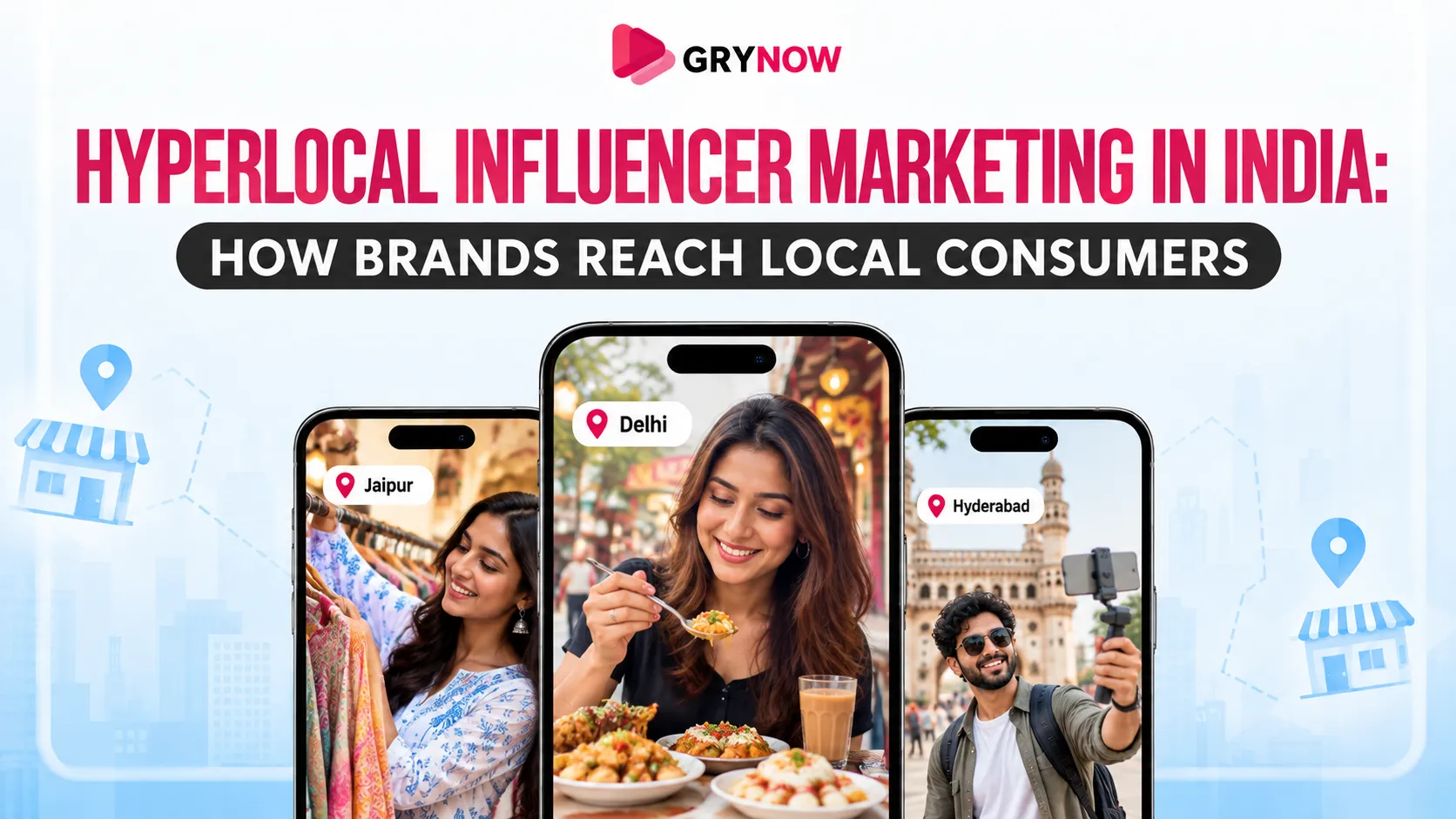
The way a consumer in Jaipur discovers a product can be very different from someone in Bengaluru or Guwahati. Language, culture, local occasions, shopping habits, and even the creators people trust can change from one market to another.
This is where hyperlocal influencer marketing is becoming increasingly relevant.
Instead of using the same influencer strategy across the country, brands are working with creators who have a strong connection with a particular city, community, neighbourhood, or local audience.
The idea is simple: when a recommendation comes from someone who understands the audience's culture and everyday context, it can feel much more relevant than a message designed for everyone.
What Is Hyperlocal Influencer Marketing?
Hyperlocal influencer marketing is the practice of working with creators who have a strong and concentrated audience in a specific geographic market.
That could mean a food creator in Mysuru, a fashion creator in Jaipur, a Marathi creator in Pune, a Bhojpuri creator based in Patna, or a creator whose content is closely connected to a particular local community.
The important part isn't simply the language.
It's the local relevance.
A national advertisement translated into six regional languages isn't necessarily a hyperlocal campaign. A hyperlocal campaign gives creators room to create content around their own local references, experiences, culture, and audience.
The difference is between:
"Here is our national campaign translated for your market."
and
"Here is a creator your market already knows, showing how this product fits into their world."
That's a very different way of communicating.
Why Hyperlocal Influencer Marketing Is Growing in India
India's digital audience is no longer concentrated only in the biggest metropolitan cities.
As internet access, digital payments, smartphones, and e-commerce reach more consumers across Tier 2 and Tier 3 markets, brands have more opportunities to reach audiences outside the traditional metro markets.
But access alone doesn't guarantee attention.
Brands still need to communicate in a way that feels relevant.
Language plays a major role here. Consumers increasingly consume digital content in regional languages, allowing brands to work with creators who already understand the cultural context of those audiences.
This is particularly important for brands expanding into new cities or smaller markets.
A creator who understands the local audience can explain a product using references, language, locations, and situations that a national campaign may overlook.
And in markets where personal recommendations and word of mouth still play an important role, that local familiarity can be valuable.
There's a genuinely good reason for the timing, and it's not just "influencers are trendy."
How Hyperlocal Influencer Marketing Works
Hyperlocal campaigns aren't simply smaller versions of national influencer campaigns.
The creator selection process changes.
1. Start With the Market
Before selecting creators, brands need to identify exactly where they want to reach consumers.
This could be:
- A specific city
- A group of Tier 2 or Tier 3 cities
- A particular pin-code cluster
- A local retail market
- A college community
- A regional festival audience
- A specific language or cultural community
The more clearly the market is defined, the easier it becomes to identify the right creators.
2. Find Creators With Local Influence
Follower count isn't necessarily the most important metric in a hyperlocal campaign.
A creator with 8,000 highly engaged followers concentrated in one city may be more useful for a local activation than a creator with one million followers spread across the country.
The key questions become:
- Where does the creator's audience live?
- How engaged are those followers?
- Does the creator understand the local culture?
- Can the creator influence an action relevant to the campaign?
For a restaurant, that action might be a visit.
For an e-commerce brand, it could be a purchase.
For an app, it could be an installation.
For a retail brand, it might be a store visit.
The creator needs to be relevant to that specific objective.
The more clearly the market is defined, the easier it becomes to select the right influencers.
3. Let Creators Build the Content
One of the biggest advantages of hyperlocal campaigns is the creator's understanding of their own audience.
Instead of giving every creator exactly the same script, brands can provide clear campaign objectives while allowing creators to adapt the content to their audience.
A creator in Jaipur may use completely different cultural references from one in Bengaluru.
That difference isn't a problem.
It's the point.
4. Connect Content With Local Moments
Local events and cultural moments can give campaigns additional relevance.
Regional festivals, local sporting events, college festivals, city-specific occasions, and community events can all provide natural opportunities for creators to introduce a brand.
The important part is authenticity.
A brand shouldn't force a local reference simply because it looks good in a campaign deck. The creator should genuinely understand and participate in that environment.
Hyperlocal vs Regional Influencer Marketing
The two approaches are related, but they aren't exactly the same.
Regional influencer marketing usually focuses on a broader geographic or linguistic audience, such as Bengali-speaking consumers across West Bengal or Marathi-speaking audiences across Maharashtra.
Hyperlocal influencer marketing goes one level deeper.
The campaign may target a specific city, neighbourhood, local community, college audience, or group of consumers within a particular market.
For example, a brand entering Maharashtra could run a regional campaign with Marathi creators across the state.
A hyperlocal strategy could instead focus on creators in Pune, Nagpur, Nashik, or specific local markets depending on where the brand wants to generate awareness or sales.
This makes hyperlocal campaigns particularly useful when the objective is not simply reach, but relevance within a specific market.
Why Micro and Nano Creators Matter
Hyperlocal influencer marketing often creates an opportunity for smaller creators.
Large influencers can provide scale, but smaller creators can provide something equally valuable: audience concentration.
Imagine two creators.
Creator A has one million followers across India.
Creator B has 12,000 followers, with a large proportion of those followers based in the city where a brand is launching.
If the objective is national awareness, Creator A may be the obvious choice.
But if the objective is to generate store visits in that particular city, Creator B may have a much stronger role to play.
This is why brands should evaluate creators based on audience relevance, location, engagement, content quality, and campaign objective, rather than follower count alone.
Where Hyperlocal Influencer Marketing Can Work Best
Hyperlocal campaigns can be particularly useful when a brand has a specific geographic objective.
Retail and D2C Brands
Brands expanding into new cities can use local creators to introduce products and drive awareness around nearby stores, launches, or offers.
Food and Hospitality
Restaurants, cafes, hotels, and food delivery brands naturally benefit from creators whose audiences live close enough to visit or order.
Fintech and Apps
Apps expanding into new markets can work with creators who understand local audiences and can explain products in familiar language.
Fashion and Beauty
Local fashion and beauty creators can demonstrate how products fit into regional preferences, occasions, and everyday routines.
Events and Local Activations
Creators can help generate awareness before an event and extend its reach through content during and after the activation.
Building a Hyperlocal Creator Ecosystem
Scaling hyperlocal influencer marketing can become difficult when brands try to manage every city independently.
Finding creators, checking audience locations, coordinating content, managing multiple languages, handling payments, tracking performance, and maintaining consistent campaign objectives can quickly become complicated.
This is where an agency or creator network can help.
A strong creator network can give brands access to creators across cities, languages, categories, and audience segments while providing a central system to manage influencer marketing campaigns.
For brands expanding beyond the metros, the goal isn't to manage hundreds of disconnected creator relationships.
It's to build a scalable system that still preserves local relevance.
Measuring a Hyperlocal Influencer Campaign
The right metrics depend on the campaign objective, which is why brands should establish a clear influencer marketing strategy before deciding what to measure.
For an awareness campaign, brands may focus on:
- Reach
- Views
- Engagement rate
- Video completion or view-through rate
- Audience demographics and location
For campaigns designed to drive action, additional metrics may include:
- Website visits
- App installs
- Coupon redemptions
- Store visits
- Leads
- Sales
- Cost per acquisition
Location should remain an important part of the analysis.
A campaign generating 500,000 views may look impressive, but if most of those views come from markets the brand doesn't serve, the number doesn't tell the whole story.
For hyperlocal campaigns, where the audience is matters almost as much as how large the audience is.
The Future of Hyperlocal Influencer Marketing in India
India's next wave of digital growth isn't going to come only from the biggest cities.
As brands enter new markets, they will need to understand the differences between those markets rather than treating the country as one audience.
That creates a larger role for local creators.
The brands that get this right won't necessarily be the ones using the biggest influencers everywhere. They will be the ones that understand which creators matter in which markets and give those creators enough freedom to communicate in a way their audiences already understand.
Hyperlocal influencer marketing isn't about making a national campaign smaller.
It's about making it more relevant.
Conclusion
India is not one audience.
A strategy that works in Mumbai may not work in Jaipur. A creator who performs exceptionally well nationally may not be the right choice for a campaign designed to drive customers to a store in a specific city.
That's why hyperlocal influencer marketing is becoming an important strategy for brands looking beyond the metros.
The opportunity is not simply to reach more people.
It's to reach the right people, in the right market, through creators they already understand and trust.
For brands looking to build campaigns across multiple cities and regional markets, Grynow, an experienced influencer marketing agency in India, helps connect brands with creators across categories, platforms, and locations, making it easier to scale creator campaigns while keeping the content relevant to the audience it is meant to reach.