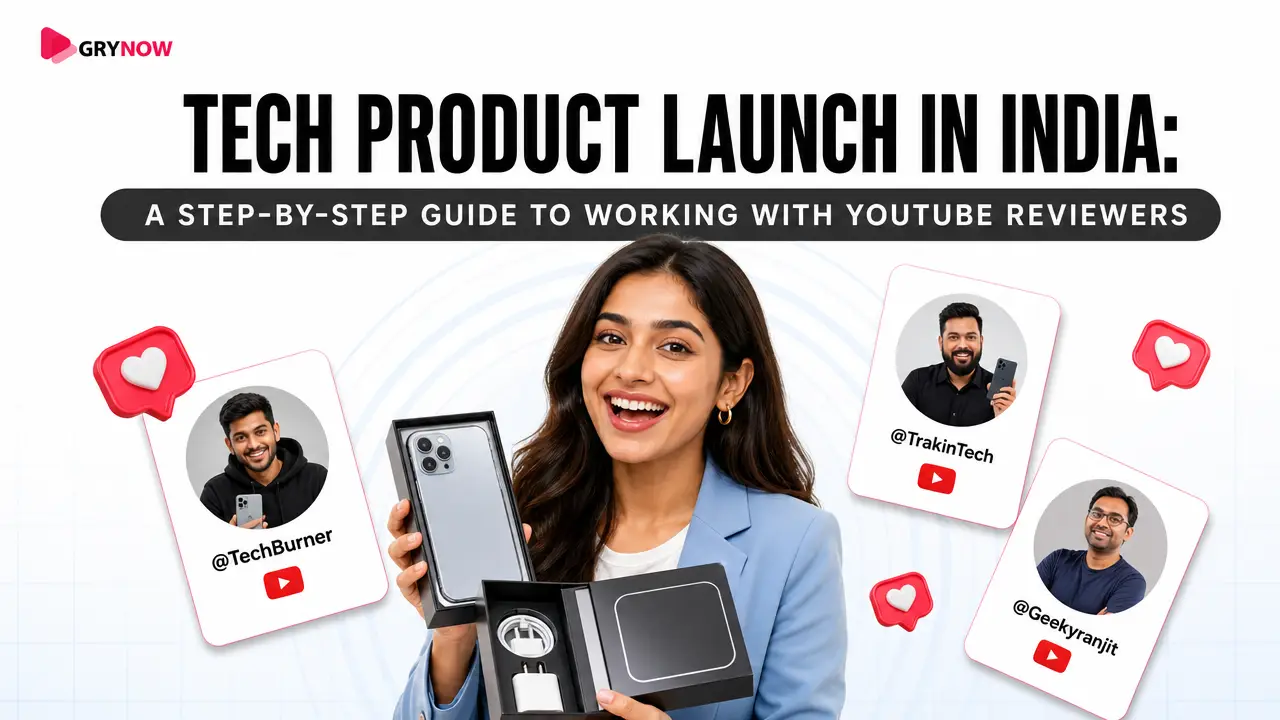
Launching a phone, wearable, smart-home device, or gaming peripheral in India is a fundamentally different exercise from launching a snack brand or a fashion label. The audience doesn't just want to see the product; they want someone credible to open the box, run the benchmarks, and tell them honestly whether it's worth the money. That single expectation reshapes almost every decision a brand has to make, from who to work with to how far in advance to plan.
This playbook walks through the mechanics of an influencer product launch for tech brands: reviewer selection, review-unit seeding, embargoes, production support, and how everything comes together into one coordinated launch campaign.
Why YouTube Reviewers Matter Before a Tech Product Launch
Why do tech and gadget brands rely on YouTube reviewers instead of Instagram influencers for launches?
Buying a phone, laptop, wearable, or gaming device is often a considered purchase. Indian consumers want to understand how the product performs before spending money on it. They may want to see camera samples, battery performance, gaming tests, build quality, software features, or comparisons with competing products.
This is where YouTube's long-form format becomes useful. A detailed review gives creators enough time to test the product and explain their experience instead of relying only on a short promotional clip.
For tech launches, YouTube can therefore play an important role in helping consumers evaluate a product before they buy, while shorter content on platforms such as Instagram can support pre-launch awareness and launch-day visibility.
What makes an influencer product launch for tech brands different from other categories?
A few things make tech launches different:
- Editorial independence matters more: reviewers built their audience by being trusted, not by being promotional, so a heavy-handed script kills the review's value instantly.
- Timing is coordinated, not staggered: the launch depends on a cluster of reviews going live around the same window, not a slow drip of posts over weeks.
- The product has to actually work: unlike a styled product shot, a review exposes bugs, poor build quality, or exaggerated specs on camera.
- YouTube unboxing is often the first real exposure: for many categories, the unboxing video is where a prospective buyer forms their first impression of packaging, in-box accessories, and build quality, well before they read a spec sheet.
Because the workflow is so different from the standard Instagram playbook, brands preparing a hardware or electronics launch usually need a partner who has actually run review cycles before, not just posted content calendars.
Getting Review Units to Creators Before Launch
How far in advance should review units be seeded to YouTubers before launch?
In practice, Indian tech YouTubers need somewhere between one and three weeks of hands-on time before the embargo lifts, depending on the complexity of the product. A budget earbud can be reviewed fairly in under a week. A flagship phone with a new camera system, a laptop that needs to be benchmarked and thermally tested over multiple sessions, or a gaming console that needs several titles played on it, all need the longer end of that window. Rushing this stage is one of the most common influencer marketing mistakes brands make: sending units two or three days before launch and expecting a thorough, considered review is unrealistic, and reviewers know it.
What should brands provide reviewers before the launch?
Along with the review unit, brands should make sure creators have everything they need to prepare their content:
- A final, retail-representative unit, not an early engineering sample that behaves differently from what ships to customers
- Accessories and packaging exactly as the customer will receive them, since unboxing content depends on this
- A spec sheet and briefing document covering what's genuinely new, so reviewers can frame comparisons accurately
- A point of contact who can answer technical questions quickly during the review window
- Freedom to keep the unit, return it, or in some cases receive it as compensation, agreed upfront and not renegotiated mid-review
The goal is to give reviewers enough time and accurate information to understand the product before launch, while allowing them to create the review in their own style and share their genuine experience.
Setting Embargoes: When to Let Reviews Go Live
What is a review embargo and how do brands set one with YouTubers?
An embargo is a simple agreement: reviewers can film, edit, and prepare their content in advance, but they hold publishing until a specific date and time set by the brand. It's typically communicated in writing at the point of product launch, along with the exact date and time zone, and it's honored on a trust basis, backed by the relationship a brand or its product launch agency has with that creator. Occasionally brands attach it to future access, making clear that breaking an embargo affects whether that reviewer gets early units next time.
How does embargo timing affect launch-day buzz?
The entire point of an embargo is to make ten or fifteen independent reviews land within the same hour or day, so that anyone searching for the product's name on launch day is met with a wall of genuine third-party coverage rather than a single trickle of videos over the following month. This concentrated review timing does two things: it maximizes search visibility right when purchase intent peaks, and it signals to the audience that this is a real, significant launch rather than a quiet release. Brands that skip embargo coordination often end up with reviews scattered across three or four weeks, which dilutes both the SEO benefit and the sense of momentum.
How to Choose the Right Reviewers for Your Tech Product Launch
How do you pick the right reviewers for a tech product launch?
Start with the product category, not the channel's overall size. A budget smartphone launch needs a different reviewer than a premium audio product or a gaming laptop, because the audience watching each channel has different price sensitivity and different priorities.
What should brands look for in a reviewer's audience and past content?
A useful shortlist process checks:
- Category fit: has this channel reviewed similar products before, and did that content perform well?
- Review format style: does the channel do in-depth reviews with benchmarks, quick unboxing-and-first-impressions content, or head-to-head comparison videos? Match the format to what your product needs shown.
- Audience price band: a channel whose audience skews toward ultra-budget devices isn't the right fit for a premium flagship, even if the subscriber count looks appealing.
- Regional language reach: India's tech YouTube audience isn't only English-speaking. Hindi, Tamil, Telugu, and other regional-language tech channels often carry significant influence within their own audience segments and are frequently overlooked by brands defaulting to the largest English channels.
- Track record of independence: check whether the reviewer has previously called out flaws in sponsored products. That's usually a good sign, not a red flag.
For gaming-specific launches, follow a related but distinct logic: audiences care less about specs in isolation and more about how a device performs in the actual titles they play, so gameplay-focused creators matter as much as pure tech reviewers.
Beyond YouTube: Where Instagram, LinkedIn, and Twitch Fit In
Should tech brands also use Instagram or LinkedIn influencers alongside YouTube reviewers?
Yes, but as a supporting layer, not the core strategy. Instagram tech influencers work well for teaser content in the run-up to launch, quick style-and-lifestyle shots of the product, and driving traffic back to the full YouTube review once it goes live. Instagram Reels and Stories are excellent at generating awareness and reach, but they can't replace the depth a buyer needs before committing to a gadget purchase.
LinkedIn influencer marketing for B2B brands has a narrower but real use case for tech launches, particularly in B2B hardware, enterprise software, or productivity devices, where the buyer is a professional evaluating the product for work rather than personal use. A founder or product lead posting a genuine take on LinkedIn can carry real weight with that specific audience, even if the reach is smaller than Instagram or YouTube.
What role does Twitch play in a gaming product launch?
Twitch influencer marketing matters specifically for gaming hardware, peripherals, and consoles, where live, unscripted gameplay is a more convincing demonstration of performance than any edited video. A streamer using a new controller or headset live, in front of a chat that asks real-time questions, produces a kind of authentic pressure-testing that a scripted YouTube review can't fully replicate. For a pure gaming peripheral launch, a combined YouTube-plus-Twitch approach usually outperforms either platform alone.
Producing Review-Ready Content: Working With Creators on Video Quality
What production support should brands offer YouTubers for high-quality review videos?
Most established tech reviewers already run their own YouTube video production process, from filming to editing, and don't need a brand to take that over. What actually helps is:
- High-resolution product renders and B-roll footage for shots the reviewer can't capture themselves (internal components, factory footage, etc.)
- A clear spec sheet and comparison data so the reviewer doesn't have to source competitor figures independently
- Access to a spokesperson for a short interview segment, if the reviewer wants one
- Fast turnaround on technical questions during editing, since delays here are what push reviews past the embargo date
How involved should a brand be in a reviewer's video production process?
As little as possible on the creative side. Reviewers who feel scripted or overly directed tend to disclose that to their audience, which undercuts the review's credibility for everyone, brand included. The value a brand adds is logistical: making sure the reviewer has everything factual they need, on time, so the finished video is accurate rather than rushed. Brands that try to approve scripts or dictate talking points are usually the same ones who end up with a shorter shortlist of reviewers willing to work with them next time.
Structuring a Full Reviewer-Led Product Launch Campaign
What does a complete reviewer-driven product launch campaign look like from start to finish?
Pulled together, the workflow generally runs in this order:
- Creator shortlisting (4 to 6 weeks out): identify tech and gaming channels matched to the product category and price band, including regional-language options.
- Outreach and agreement (3 to 5 weeks out): confirm participation, review format, and embargo terms with each creator.
- Seeding (1 to 3 weeks out, depending on product complexity): ship retail-representative units with full accessories and a briefing document.
- Production window: reviewers film, test, and edit while the brand stays available for technical questions.
- Embargo lift: all agreed reviews publish within the same coordinated window on launch day.
- Amplification: Instagram, LinkedIn, and Twitch activity supports and extends the reach of the YouTube reviews rather than replacing them.
- Post-launch monitoring: track sentiment across reviews and comments to catch recurring product feedback early.
When does it make sense to bring in a product launch agency for this?
Once you look at that list end-to-end, the reason most tech brands don't run this in-house becomes clear: it requires simultaneously managing logistics (shipping, timing, accessories), relationships (creator vetting and negotiation), and coordination (getting a dozen independent parties to honor the same embargo). A specialist product launch agency exists precisely to run this workflow repeatedly, with existing relationships across unboxing, benchmark, and gaming channels already in place, rather than a brand building that creator network from scratch for a single launch.
![Top 100 Indian Gamers on Youtube[Updated List 2022]](../assets/blog/top-indian-gamers-on-youtube/thumbnail.webp)