Influencer marketing gives brands a direct way to reach audiences through creators they already follow and trust. But once a brand decides to work with influencers, another important question comes up:
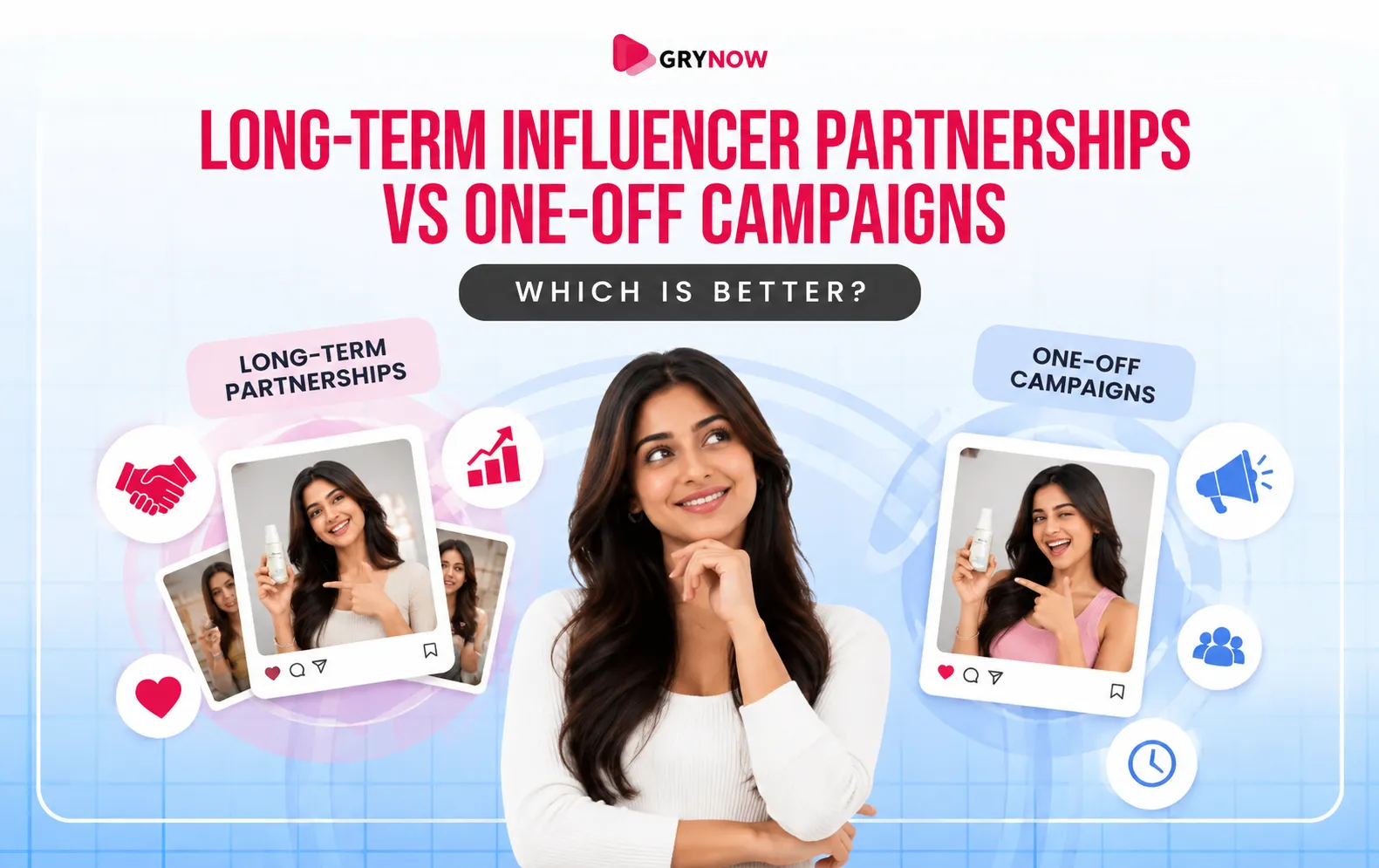
Should you run a one-off influencer campaign or build a long-term influencer partnership?
Both approaches can work. A one-off campaign can help a brand generate quick visibility, test creators, support a product launch, or drive a seasonal promotion. A long-term partnership can help build familiarity, strengthen brand association, and create a consistent stream of creator content over time.
The better option depends on your campaign objective, budget, product, audience, and relationship with the creator.
In this guide, we'll compare one-off influencer campaigns with long-term influencer partnerships, including their benefits, limitations, costs, and the situations where each approach makes the most sense.
Quick Answer: Long-Term Partnerships vs One-Off Campaigns
One-off influencer campaigns are generally better for short-term objectives such as product launches, seasonal promotions, creator testing, and quick bursts of awareness. Long-term influencer partnerships are better suited to brands that want to build familiarity, trust, consistent content, and stronger creator-audience associations over time.
A practical approach for many brands is to start with a smaller one-off collaboration, measure the results, and then build longer-term relationships with creators who prove to be a strong fit.
In simple terms:
One-off campaigns help you test and activate. Long-term partnerships help you build and compound.
What Makes an Influencer Campaign Successful?
Before deciding between a one-off campaign and a long-term partnership, brands need to get the fundamentals right.
To create a successful influencer marketing campaign, format matters, but it cannot compensate for the wrong audience, unclear objectives, poor creator fit, or weak measurement.
1. Know Exactly Who You're Talking To
"Anyone trying to be healthier" isn't a defined audience.
Working professionals in their late twenties with desk jobs who want simple ways to stay active are much easier to target.
The more clearly you understand your customer, the easier it becomes to identify creators whose audiences actually overlap with your target market.
2. Define the Campaign Objective
Define your campaign goal: what are you trying to achieve?
- Launching a new product
- Reaching a new audience
- Testing a new creator category
- Driving sales
- Building brand awareness
- Generating UGC
- Creating demand before a major launch
- Building long-term brand recall
Your answer should determine the creators you choose, the content you produce, the campaign duration, and the metrics you track.
If you're still defining the broader campaign structure, Grynow's guide on how to create a successful influencer marketing campaign covers objectives, creator selection, content planning, execution, and measurement.
3. Look Beyond Follower Count
A large audience does not automatically mean better campaign results.
Brands should consider engagement quality, audience relevance, content fit, clicks, conversions, and previous campaign performance alongside reach.
A creator with 30,000 relevant and engaged followers can be more useful for a niche campaign than a creator with 300,000 followers whose audience has little connection to the product.
4. Give Creators Room to Create
People follow creators because they have a particular voice, personality, format, or perspective.
If a brand turns a creator collaboration into a rigid script filled with mandatory talking points, the content can lose the natural quality that made the creator valuable in the first place.
A strong brief should communicate the campaign objective, key product information, mandatory requirements, and boundaries while still giving creators enough room to communicate in their own style.
5. Give the Audience a Clear Next Step
A campaign needs a clear action.
Depending on the objective, that could be:
- Visiting a website
- Using a discount code
- Signing up
- Downloading an app
- Requesting a demo
- Purchasing a product
- Following the brand
- Watching another piece of content
The CTA should match the campaign objective rather than being added as an afterthought.
Once these fundamentals are in place, the next decision becomes much easier: should the creator relationship end after one activation, or should it continue?‘
What Is a One-Off Influencer Campaign?
A one-off influencer campaign is a collaboration with a defined beginning and end.
The brand and creator agree on specific deliverables, timelines, compensation, and campaign requirements. Once the agreed content is published and the campaign is completed, there is no automatic expectation of another collaboration.
For example, a D2C skincare brand might work with 20 creators to promote a new product during a launch week. Each creator publishes one Reel and supporting Stories, the brand tracks the results, and the campaign ends.
One-off campaigns are often useful when a brand wants to test, activate, or create a short-term spike in attention.
When Should a Brand Choose a One-Off Influencer Campaign?
A one-off campaign can make sense when:
You are launching a product
Product launches often require concentrated attention within a specific timeframe. Working with multiple creators around the launch date can help create initial awareness and social proof.
You want to test creators
If you're working with a creator for the first time, a smaller collaboration can help you understand their audience, content quality, communication, and campaign performance before committing to a longer relationship.
You are running a seasonal promotion
Festivals, sale periods, new-season launches, and other time-sensitive events can benefit from a concentrated influencer push.
You want to test different audiences
A brand entering a new category or market can work with several creator types to understand which audience responds most strongly.
You have a limited initial budget
A one-off campaign gives brands more control over how much they commit before they have enough performance data to justify a longer partnership.
This approach is particularly useful for newer brands that want to learn from their first campaign before scaling their influencer marketing investment.
What Are the Limitations of One-Off Influencer Campaigns?
One-off campaigns can be effective, but they also have limitations.
1. Limited relationship-building
One collaboration gives the creator limited time to understand the brand, product, and audience.
As a result, the content may not have the same depth or familiarity that develops through repeated collaborations.
2. Less opportunity to build brand recall
If an audience sees a creator mention a brand only once, the association may be weaker than when the same creator naturally features the brand several times over a longer period.
3. More creator turnover
Brands running only one-off campaigns may need to repeatedly identify, vet, negotiate with, brief, and manage new creators.
That can increase operational workload.
4. Less predictable creator performance
Every new creator relationship involves some degree of uncertainty.
A creator can look promising based on their profile and previous content but perform differently once the actual campaign goes live.
5. Shorter content lifespan
The campaign may generate strong attention during its active period, but brands may have fewer opportunities to build on that attention unless the content can be reused or the relationship continues.
What Is a Long-Term Influencer Partnership?
A long-term influencer partnership is an ongoing relationship between a brand and creator involving multiple collaborations over an extended period.
Instead of treating each post as a separate transaction, the creator becomes a recurring part of the brand's communication strategy.
The creator may feature the brand across multiple campaigns, products, launches, or content formats.
Over time, the relationship can develop into a brand ambassador partnership, where the creator becomes strongly associated with the brand.
This approach can be particularly valuable when familiarity and repeated exposure are important to the purchase journey.
When Is a Long-Term Influencer Partnership Worth It?
A long-term partnership can make sense when:
You want to build brand familiarity
Repeated exposure can make a brand more familiar to an audience than a single sponsored post.
The creator is already a strong fit
If a creator consistently reaches the right audience, produces quality content, and delivers meaningful campaign results, continuing the relationship can make sense.
Your product requires trust
Products in categories such as beauty, skincare, wellness, finance, technology, and lifestyle can benefit from creators demonstrating or discussing the product repeatedly over time.
You need a consistent stream of creator content
Long-term partnerships can provide brands with recurring content that may support organic social media, paid advertising, websites, product pages, and other marketing channels, subject to agreed usage rights.
You want stronger creator-brand collaborations
When audiences repeatedly see the same creator using or discussing a product, that makes the creator-brand collaboration stronger
What Are the Benefits of Long-Term Influencer Partnerships?
1. Stronger Brand Familiarity
Repeated exposure gives audiences more opportunities to recognize and understand the brand.
2. More Natural Content
As creators become more familiar with a product, they can often communicate about it with greater context and less reliance on scripted messaging.
3. Better Creator Relationships
A longer relationship allows brands and creators to understand each other's expectations, communication styles, timelines, and creative preferences.
4. Consistent Content Production
An ongoing partnership can create a more predictable pipeline of creator content rather than requiring the brand to start the creator-selection process from scratch for every campaign.
5. More Learning Over Time
One campaign provides one set of results.
A longer relationship gives brands multiple opportunities to learn which products, messages, formats, and content angles perform best with a particular creator's audience.
What Should Brands Watch Out for With Long-Term Partnerships?
Long-term partnerships aren't automatically better. They require active management.
1. Don't commit before testing the relationship
A creator may look perfect on paper but perform differently in an actual campaign.
Where possible, use an initial collaboration to evaluate fit before entering a longer agreement.
2. Keep measuring performance
Track relevant metrics throughout the partnership rather than assuming performance will remain strong.
Depending on the objective, this can include:
- Reach
- Views
- Engagement
- Click-through rate
- Website traffic
- Leads
- Conversions
- Sales
- Cost per acquisition
- Content performance
For a deeper look at campaign measurement, see Grynow's guide on how to measure and maximize influencer marketing ROI.
3. Avoid creative fatigue
Even a successful creator partnership can become repetitive if every campaign uses the same format.
Rotate products, hooks, formats, offers, and storytelling approaches while keeping the creator's voice consistent.
4. Don't continue a partnership simply because it is established
If the creator's audience changes, campaign performance declines, or the brand's objectives change, reassess the relationship.
Long-term should mean strategic and ongoing, not permanent regardless of performance.
Long-Term Influencer Partnerships vs One-Off Campaigns
| Factor | One-Off Campaigns | Long-Term Partnerships |
|---|---|---|
| Timeline | Short and fixed | Ongoing |
| Relationship | Campaign-based | Recurring partnership |
| Speed | Faster to launch | Requires more planning |
| Creator testing | Excellent for testing | Better after creator fit is established |
| Brand familiarity | Limited | Can build over time |
| Content volume | Campaign-specific | Recurring content |
| Budget commitment | Lower initial commitment | Greater ongoing commitment |
| Flexibility | Easy to change creators | More relationship-dependent |
| Best suited for | Launches, promotions, testing | Brand building, recurring campaigns, ambassador programs |
| Main challenge | Limited continuity | Requires ongoing management |
| Measurement | Campaign-specific results | Performance over multiple campaigns |
Which Is Better: Long-Term Partnerships or One-Off Campaigns?
Neither approach is universally better. The right choice depends on the campaign objective and the stage of the brand-creator relationship.
Choose a one-off influencer campaign when your priority is:
- Testing a new creator
- Launching a product
- Supporting a seasonal promotion
- Reaching a new audience
- Generating short-term visibility
- Learning which creator types perform best
Choose a long-term influencer partnership when your priority is:
- Building brand familiarity
- Creating recurring content
- Developing stronger creator-audience associations
- Maintaining a consistent creator presence
- Building an ambassador program
- Learning and optimizing across multiple campaigns
For many brands, the most practical approach is not to choose one model permanently.
Start with a focused campaign, measure the results, identify the creators who demonstrate strong audience fit and campaign performance, and then consider expanding those relationships.
That creates a progression:
Test → Measure → Identify strong creators → Build partnerships → Optimize
Can Brands Use Both One-Off and Long-Term Influencer Campaigns?
Yes.
A brand can use both approaches as part of the same influencer marketing strategy.
For example:
One-off campaigns can be used for:
- Product launches
- Seasonal promotions
- New creator testing
- Market testing
- Campaign-specific pushes
Long-term partnerships can be used for:
- Always-on brand storytelling
- Product education
- Recurring promotions
- Ambassador programs
- Consistent social proof
- Ongoing content creation
This hybrid model gives brands room to experiment with new creators while maintaining deeper relationships with proven partners.
Grynow's existing guide on the differenttypes of influencer marketing campaigns also covers formats such as paid collaborations, product seeding, affiliate campaigns, brand ambassadorships, UGC campaigns, and product launch campaigns. This article, however, focuses specifically on the duration and relationship model rather than campaign type.
How Do You Know When to Turn a One-Off Collaboration Into a Long-Term Partnership?
Look at both performance and relationship fit.
A creator may be worth considering for a longer partnership when:
- Their audience matches your target customer.
- Their content fits your brand naturally.
- They consistently generate meaningful engagement.
- They drive measurable campaign results.
- Their audience responds positively to sponsored content.
- Communication and execution are reliable.
- They show genuine interest in the product.
- Their content continues to feel fresh rather than repetitive.
Don't make the decision based on one viral post.
Look at performance across the campaign and, where possible, compare it with the creator's previous collaborations and organic content.
Conclusion
One-off influencer campaigns and long-term influencer partnerships serve different purposes.
One-off campaigns are useful for testing, launches, seasonal promotions, and short-term activation. Long-term partnerships are useful for building familiarity, consistency, recurring content, and deeper creator relationships.
The decision shouldn't be based simply on which model sounds more effective. It should be based on what the brand is trying to achieve and what the campaign data shows.
For many brands, the strongest approach is to test first, measure carefully, and build longer relationships with creators who consistently prove their value.
That turns influencer marketing from a series of isolated posts into a more structured creator strategy that can improve with every campaign.