A 23-year-old tech reviewer in Bengaluru posts a 45-second Instagram Reel comparing two flagship phones. By the next morning it's crossed two million views. Comments are pouring in, the algorithm is clearly in love with it, and for a moment, it feels like the win of the month.
Then the brand invoice for that Reel comes through, and it's a fraction of what the same creator earned the week before for a 14-minute YouTube video reviewing a single mid-range smartphone, watched by a much smaller audience.
This isn't a one-off story.
It's the exact tension playing out across India's creator economy right now. YouTube is rewarding long-form. Instagram is rewarding Reels. Podcasts are having a real moment. Moj and Josh are paying regional creators to go vertical and short. Every creator in India is asking the same blunt question: where should I actually put my energy if I want to make real money, not just rack up views?
Here's the honest truth and what it means for brands trying to build campaigns that don't just get watched but actually work.
How Do Long-Form and Short-Form Content Actually Work?
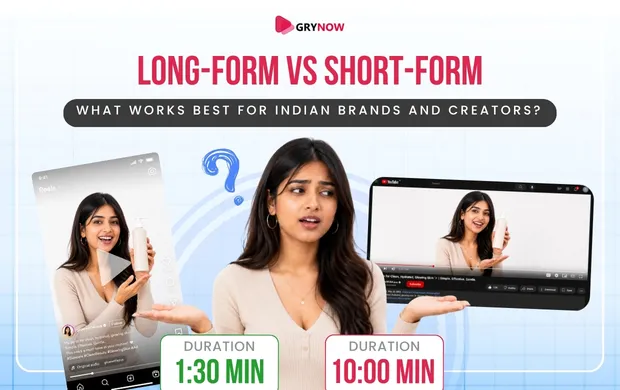
Long-form content is YouTube videos, podcasts, and anything past the 3-minute mark content that asks for real time from the viewer.
Short-form is Instagram Reels, YouTube Shorts, and platforms like Moj and Josh, which are fast, vertical, and built to be consumed in a scroll.
Over the last three years, creator behavior in India has shifted quite a bit.
Short-form exploded first because of Instagram's algorithm, which gave Reels a massive head start. But as that space got crowded, smart creators started doing something interesting.
Using their short-form reach to pull people into long-form content, where the real relationship and the real money get built. The creators (and brands) winning right now are the ones using both formats for exactly what each one is good at.
Short-Form vs Long-Form: An Honest Comparison
| Factor | Short-form | Long-form |
|---|---|---|
| Discovery & Reach | Very high | Moderate |
| Brand Deal Value | Lower per post | Higher per video |
| Platform Revenue | Low | High |
| Audience Loyalty | Moderate | Very High |
| Content Shelf Life | 24-48 hours | Months to Years |
| Best For | Awareness Campaigns | Trust and Conversion |
| Top Platforms | Instagram and Youtube shorts | Youtube, Spotify and Podcasts |
Neither side of this table is "winning."
Short-form gets you seen. Long-form gets you believed.
A campaign that only does one of these is leaving half its potential on the table, which is exactly why the smartest brands are no longer choosing between them.
What Brands Are Actually Paying For?
India's creator economy is projected to grow from roughly $1.5 billion in 2025 to nearly $6 billion by 2032, and a growing share of that money isn't going into one format; it's being deliberately split. Coherent.com
Long-form integrations typically command 3 to 5 times the price of a single Reel, and once you think about it, that math makes complete sense. A YouTube creator doing a 12-minute product review is holding an audience's undivided attention for 12 straight minutes.
That's not something a 30-second Reel can offer an advertiser, no matter how many views it racks up. That extended attention is exactly what drives recall and purchase intent, which matters enormously for considered, higher-ticket products.
But the brands getting this right aren't choosing one over the other. They're running both, deliberately, at the same time: short-form to build buzz fast and long-form to close the loop and actually convert. Short-form earns the eyeballs. Long-form earns the trust. You need both to make the sale.
A Real Example: How This Plays Out in Practice
Grynow designed a campaign for Pantene's oil replacement product.
The brief was to boost product visibility and actually move people from "aware" to "ready to buy."
Grynow brought in 30 beauty and lifestyle creators, ranging from macro to mega tier, and had them create detailed, demonstration-style content actually showing how the product works, not just flashing it on screen for two seconds.
That's the kind of content that needs real explanation and time to land; you can't convincingly show someone how a product transforms their hair in a 10-second clip. It needs depth.
The result: 40 million+ views across 30 videos in a single month.
This was a depth-focused, demonstration-led content, and it still scaled massively. That's the proof point brands need: you don't have to sacrifice scale to get substance. With the right creator mix and the right execution, you get both.
How Grynow Helps Brands Get This Balance Right?
This is exactly the gap most brands can't close on their own and exactly where having the right agency partner changes the outcome.
Grynow, India's top influencer agency, helps brands to execute end-to-end influencer marketing campaigns by integrating winning strategies and matching ideal influencers that align with their objectives and figuring out which format actually fits which goal, instead of defaulting to whatever's trending that week. A launch that needs fast, wide visibility gets a short-form-led push. A product that needs real explanation, a feature comparison, a complex use case, or a high-consideration purchase gets the long-form treatment, the way Pantene's campaign did.
With 10 years of experience and 1500+ brand campaigns under our belt, we've seen what actually moves the needle across categories, including tech, where audiences are sharp, skeptical, and quick to spot content that feels rushed or surface-level.
We match brands with creators using real audience data that is engagement quality, audience overlap, and proven format performance, not just follower count. We manage the whole thing end-to-end, from creator selection to content approval to performance reporting, so brands aren't left guessing whether their short-form spend and long-form spend are actually working together toward the same goal.
Conclusion
The long-form vs short-form debate is the wrong question. The right question is
What does your audience actually need, and where are they most ready to engage?
For creators, the money follows consistency and strategy, not format. For brands, the smartest campaigns use both, deployed with intent instead of habit.
Grynow understands both sides of this equation and has the track record, from campaigns like Pantene's, to prove it.
So, is your brand's content strategy actually built around where your audience is ready to engage, or just where it's easiest to post?