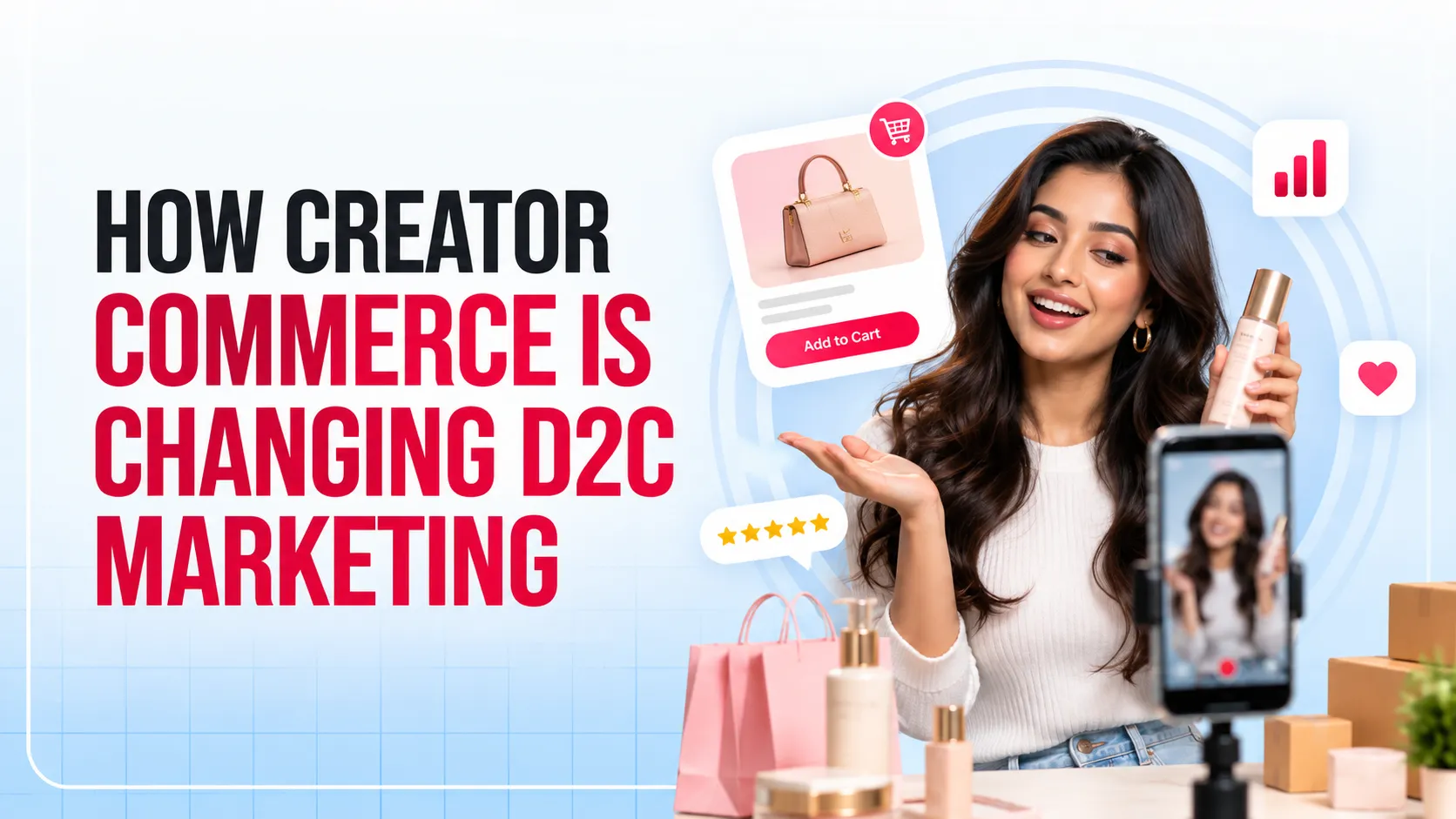
Just suppose you're scrolling through Reels and just half-thinking about something else, and then a creator holds up a product they actually use, talks about it like they would to a friend, and twenty minutes later there's a new item in a cart that wasn't there before.
Nobody planned that purchase. It just happened, somewhere between a swipe and a story.
A single creator posts about the product, and the sales dashboard tells the story before the customer support team does: a spike no traditional ad campaign explains, tied to one video, one voice, and one honest-sounding recommendation.
"The modern creator is not just renting attention anymore; they are monetizing community," one of the investors recently remarked at a D2C summit. This line explains why creator commerce has stopped being a passing e-commerce trend and become an increasingly important part of D2C marketing. It's a deeper shift in how consumer trust itself is being connected to the buying journey.
The numbers back this up.
According to Markets & Data, India's D2C market was valued at roughly $42.59 billion in FY2024 and is projected to cross $185 billion by FY2032. As D2C brands continue looking for more direct ways to reach consumers, creator-led commerce is becoming an increasingly important part of that growth story, connecting product discovery with trust and purchase.
How Creator Commerce Is Changing the Way Indians Buy
The Indian buyer of today isn't the same buyer brands were selling to five years ago.
A purchase now comes with questions attached:
What's this made of?
Does the brand actually stand for something?
Will this sit in a landfill in six months?
That's why "conscious" isn't a marketing buzzword anymore; it's a filter people increasingly apply to their purchases.
A skincare brand that plants a tree with every order, a fashion label that's upfront about its supply chain, and a snack company that skips the plastic, these details can influence product decisions in a way that a discount code alone doesn't. Mamaearth built an entire brand identity around this instinct, and it worked because the promise was simple enough to repeat: buy from us, and something good happens beyond the transaction.
At the same time, creators have become an important part of how consumers discover, evaluate, and talk about these products. A creator can demonstrate how a product fits into everyday life, answer questions in the comments, and give an unfamiliar brand a human voice.
Two forces are accelerating this shift toward creator-led and social buying at the same time:
Access Has Collapsed the Distance Between Discovering and Buying
A product can go from "never heard of it" to "in my cart" within the same scroll session, with no store visit and no waiting. The path from product discovery to purchase can now happen on the same screen. This is one of the reasons social commerce has become an important part of the modern buying journey.
For Many Gen Z Consumers, the Shopping Journey Increasingly Begins in the Feed
Social platforms are no longer only places where young consumers hear about products. They are also spaces where they discover products, watch demonstrations, compare opinions, and decide whether something is worth buying. A recommendation from a creator they already trust can feel more relevant than a traditional banner ad.
Put those two together, and creator commerce stops being a nice-to-have.
It becomes an increasingly important entry point for D2C sales.
Why D2C Brands Are Betting on Creator Partnerships Right Now
Ask a founder why they're putting budget into creator partnerships instead of relying only on traditional advertising, and the answer usually comes down to a simple trade: relevant content, stronger audience connection, and a level of trust that conventional paid media can struggle to replicate.
But the real advantage shows up after the campaign ends.
A polished ad stops working the moment the spend stops. A good piece of creator content doesn't always behave that way; it can be watched again, shared into a group chat, saved for later, and referenced in a comment section weeks after it was posted.
The brand can continue getting value from that piece of content long after the initial campaign is over.
That makes creator partnerships particularly interesting for D2C brands, where the same piece of content can influence discovery, consideration, and eventually purchase, much like influencer marketing for e-commerce.
Few other formats in D2C marketing can create that kind of extended content value, and it's one reason creator-led commerce is becoming an important part of the modern D2C marketing mix.
Where Creator Commerce Goes Wrong
Let's understand where creator commerce can go wrong for a brand.
Plenty of brands have already jumped into creator commerce, and plenty are quietly disappointed by the results.
The pattern is usually the same.
A creator sends real, warm interest toward a brand and people click because they trusted the recommendation, not simply because an algorithm pushed an ad in front of them.
And then that interest lands nowhere.
There's no attribution telling the brand which creator partnership actually drove the sale, making it difficult to measure influencer marketing ROI and understand which partnerships are worth scaling.
There's no landing experience built for the mood the viewer was in when they clicked.
There's no structure turning a moment of trust into a completed transaction.
The brand ends up with vanity numbers that explain views, likes, and reach but don't answer the question that matters most:
Did this creator partnership actually contribute to D2C sales, and can we repeat what worked?
That's the real gap in creator commerce today.
The creator does the hard part, which is building the trust.
What happens in the next sixty seconds after someone clicks is what can determine whether that trust turns into revenue.
It's the difference between treating a creator partnership as a one-off marketing spend and treating creator-led commerce as an actual channel, one that can be tracked, tested, and scaled alongside performance marketing, email, and other measurable D2C channels.
That’s where the role of an experienced influencer marketing agency in India becomes important. Grynow helps brands build creator partnerships with a focus on campaign execution, content, audience connection, and measurable marketing outcomes, helping turn creator activity into a more structured D2C growth channel rather than a one-time spike on a dashboard.
How D2C Brands Can Make Creator Commerce More Measurable
Creator commerce works best when the creator partnership doesn't end with the post going live.
Brands need to build a clear path from creator content to purchase.
A few elements can make that journey more measurable:
Give Every Creator a Trackable Purchase Path
Unique links, discount codes, landing pages, or other attribution methods can help brands understand which creator partnerships are generating meaningful actions.
Match the Landing Experience to the Creator Content
If a creator recommends a particular product, sending the audience to a generic homepage can create unnecessary friction. The landing page should continue the same product story and make the next step clear.
Look Beyond Views and Likes
Reach and engagement can help evaluate content performance, but D2C brands also need to consider clicks, add-to-cart actions, conversions, revenue, and customer acquisition costs where reliable attribution is available.
Identify Creators Who Can Drive Action
A creator with a large audience isn't automatically the right creator for a D2C campaign. Audience relevance, content quality, trust, engagement, and the creator's ability to influence purchase decisions can all matter.
This is where creator commerce starts looking less like a traditional influencer campaign and more like a measurable marketing channel.
Conclusion
Creator commerce isn't a phase D2C marketing is simply passing through; it is becoming an increasingly important way for brands to connect trust, product discovery, and purchasing in India.
The brands that treat it seriously, with real attribution, real optimization, and real structure behind every creator partnership, can turn today's scroll-and-buy moments into a social commerce channel they can measure and improve over time, rather than simply chasing a good quarter of reach and engagement.
The future of D2C marketing isn't only about getting consumers to see a product.
It's about making the journey from creator recommendation to customer purchase easier to understand, measure, and scale.