On a January night in Ahmedabad, 2.2 lakh people filled Narendra Modi Stadium to watch Coldplay play two shows. Hotels in the city were sold out weeks in advance. Cab fares were spiked. Street vendors near the stadium reportedly did a month's business in two nights.
By the time the lights came up, the concert had pushed an estimated ₹641 crore through the local economy, where ₹392 crore of it landed directly in hotels, restaurants, transport, and retail, and ₹72 crore of it went straight into GST collections, according to an EY-Parthenon and BookMyShow report.
None of that money came from steel, cement, or anything you could put in a container and ship.
It came from two nights of music, a stage, and an audience that showed up because it wanted to.
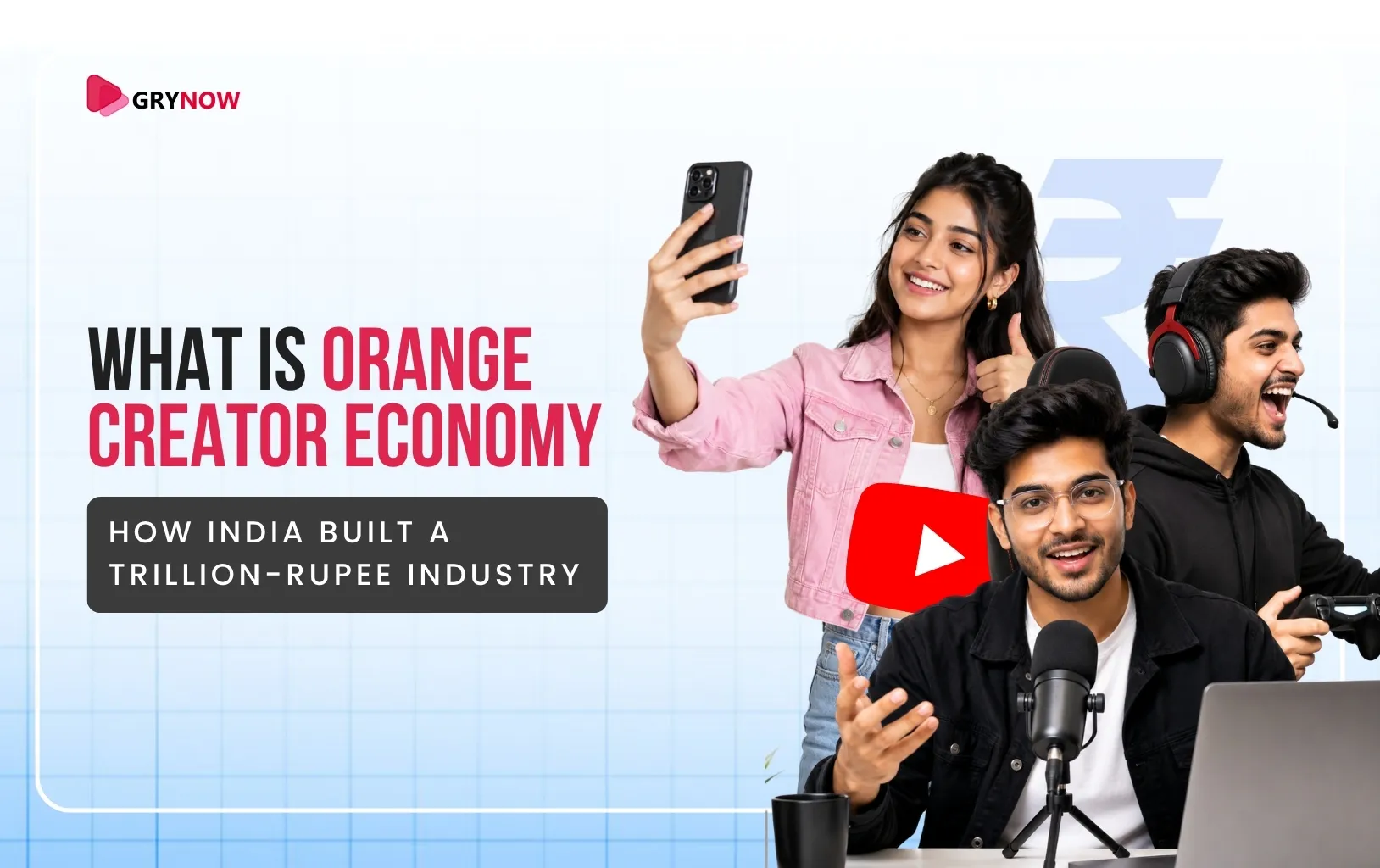
That, in one very loud example, is what people now mean when they talk about India's "Orange Creator Economy."
What is the Orange Creator Economy?
The Orange Creator Economy refers to India’s fast-growing ecosystem of YouTubers, gamers, streamers, Instagram influencers, and podcasters who have transitioned beyond posting content to building it into a business, launching products, owning intellectual property, and monetizing their audience like how a traditional company monetizes its customer base. It sits inside India's broader "Orange Economy," the government's umbrella term for industries where creativity and IP, not raw materials or manufacturing, are the primary source of economic value.
Where does the name “Orange” actually come from?
The word "orange" wasn't picked at random.
Back in 2013, Colombia's former President Iván Duque Márquez and his co-author Felipe Buitrago wrote a book called The Orange Economy: An Infinite Opportunity, arguing that a whole category of value creation, including film, music, design, publishing, and games, deserved its own color on the economic map.
They chose orange because, across cultures, it's long been tied to creativity, culture, and identity.
The idea underneath it is simple.
In an ordinary economy, value comes from something physical: a car, a bag of cement, a phone.
In the orange economy, value comes from an idea that gets protected and sold as intellectual property, like a script, a song, a game, a brand campaign, or a logo. The raw material is imagination, and unlike coal, it doesn't run out when you use it.
From Just a Hobby to a New Economy
Five years ago, if you wanted to become a full-time creator in India, there was no map for it. You worked it out alone, usually with a phone, bad lighting, and a lot of trial and error.
That's no longer entirely true.
The shift became official in the Union Budget 2026-27, where the government explicitly named creative industries like animation, VFX, gaming, comics, media, design, and live events as a priority for jobs and growth.
The reasoning wasn't sentimental. India's Economic Survey 2025-26 had already projected that the AVGC-XR sector alone would need close to 2 million skilled workers by 2030, and there was simply nowhere for that many people to get trained.
The Growth of Regional Influencers
For most of the years, "influencer" in India quietly meant someone posting in English, based in a metro, talking to an urban, English-speaking audience.
Somewhere between 65% and 73% of Indian internet users now say they prefer content in their own language, and YouTube India has reported that over 60% of its watch time now comes from regional-language videos, not English ones.
Tamil creators grew their follower bases by more than 300% through 2025. Bengali comedy channels picked up roughly 15 million new subscribers in a single year. Marathi lifestyle creators, who a few years ago struggled to land any brand deal at all, are now signing serious campaigns. South India alone is estimated to account for close to a third of all regional influencer marketing spend, including cities like Kochi, Coimbatore, and Hyderabad.
Vernacular content reportedly earns two to three times more engagement than English content in Tier-2 and Tier-3 cities, where a familiar accent and a shared cultural reference do more for trust than a follower count ever could.
How are Creators Building Businesses?
The old creator playbook was simple: post, get views, get a brand deal, repeat.
The new one looks a lot more like running a company.
Independent creators today are launching live events, courses, and even their own product lines, instead of stopping at sponsored posts.
Influencer marketing agencies like GRYNOW have grown up around them and, in doing so, have changed what a creator's job actually involves. Many now host brand launches, front entire ad campaigns, or become, functionally, the public face of a company that isn't even theirs.
Boston Consulting Group has estimated that Indian creators already influence upward of $350 billion in annual consumer spending, a figure it expects to cross $1 trillion by 2030.
AI is Doing the Operations
None of this scales without something helping in the background, and that is AI.
Grynow, a top influencer marketing agency in India, now runs largely on AI-powered dashboards that match creators to campaigns, flag fake engagement, and track performance in real time and manage thousands of creators across a dozen regional languages.
The Quiet Rise of the Concert Economy
Prime Minister Narendra Modi has used that exact phrase, "concert economy," to describe how live events have become an economy of their own. India's organized live events sector crossed roughly ₹12,000-14,500 crore in 2024, growing close to 17-19% a year and projected to create around 12 million jobs by 2032.
More than half a million Indians reportedly traveled between cities for live music in a single year, people booking flights and hotels for a two-hour show in a way that would have seemed strange a decade ago.
Conclusion
The Orange Creator Economy isn't really a new invention; it's an old idea about culture and value finally getting the infrastructure and the name to match what was already happening.