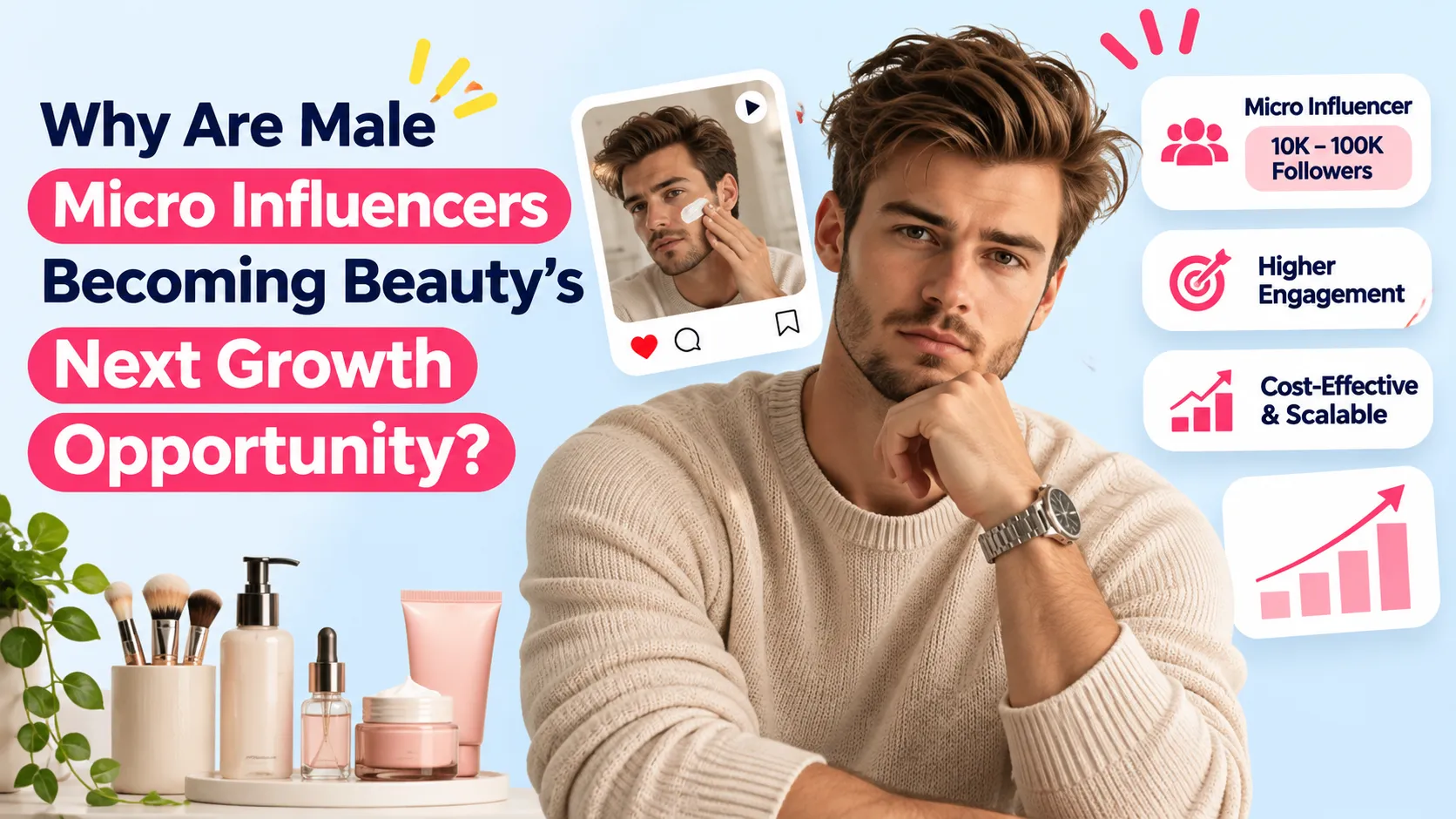
Quick answer
Male micro and nano creators now drive roughly 65% of all men's grooming brand collaborations in India, and nano accounts post a 2.1% median engagement rate versus 1.18% for macro creators, nearly 1.8x higher. For beauty brands chasing male shoppers, smaller, niche-focused male creators deliver more trust and conversation per rupee than celebrity-scale reach.
Beauty marketing has spent a decade building playbooks around female creators, and for good reason — women still make up most skincare and makeup audiences. But men's grooming, skincare and fragrance are among the fastest-growing beauty subcategories in India, and the creators best placed to speak to that audience aren't the celebrity names brands default to. They're male micro creators: barbers, grooming hobbyists, skincare-curious guys with 10,000 to 100,000 followers who post routines, reviews and honest before-afters. This article looks at what collaboration data from the men's grooming category shows about how these creators actually perform, where they fit in a brand's creator mix, and what it takes to work with them well. The numbers point to a specific opportunity: a segment that is cheaper to book, harder to ignore in the comments section, and still under-used by most beauty marketing teams.
The Male Beauty Audience Brands Are Still Catching Up To
Men's grooming in India has moved well past razors and deodorant. Beard oils, face washes, serums, hair styling ranges and even multi-step skincare are normal purchases now, and the buyers are younger, more online and more willing to try a product because a creator they follow used it on camera. The problem for brands is that most of their creator budgets are still built around macro and mega names, which work for awareness but say little about whether a 25-year-old man believes a face wash is worth buying. Micro creators, who built their following by actually caring about grooming rather than being cast into a beauty campaign, close that gap.
What the Collaboration Data Shows
Source: Grynow Insights · 5,503 collabs · 2026-05-30 to 2026-11-26
Looking at men's grooming brand collaborations over the past six months (2026-05-30 to 2026-11-26), the category logged 5,503 collabs across 2,849 creators and 157 active brands. Nano and micro creators together accounted for 64.9% of that volume not a niche tactic, but the bulk of how the category actually runs its creator programs.
Methodology
Engagement rate is (likes + comments) ÷ views per collaboration post; figures below are medians, not averages, and tiers are based on each creator's follower count at the time of posting.
Engagement by creator tier
Median engagement rate by creator tier – Men's Grooming
Nano creators post a 2.1% median engagement rate, micro creators 1.41%, macro creators 1.18%, and mega accounts 1.48%. That means a nano grooming creator's audience engages at close to 1.8x the rate of a macro creator's, and a micro creator's rate still runs about 1.2x higher than macro. Reach tells the opposite story: macro accounts average 375,835 views per post against 68,351 for nano accounts, roughly 5.5x more. The trade-off is straightforward — macro buys you scale, micro and nano buy you a more engaged, more persuadable audience per post.
| Tier | Collabs | Median ER (%) | Avg views | Repeat rate (%) |
|---|---|---|---|---|
| nano | 1,689 | 2.1% | 68,351 | 20% |
| micro | 1,881 | 1.41% | 98,450 | 14.2% |
| macro | 1,425 | 1.18% | 375,835 | 17.6% |
| mega | 508 | 1.48% | 2,569,497 | 23.4% |
Source: Grynow Insights · 5,503 collabs · 2026-05-30 to 2026-11-26
Repeat booking rates add another layer: nano creators get rebooked by the same brand 20% of the time and mega creators 23.4%, both higher than micro (14.2%) and macro (17.6%). Brands that work with a nano grooming creator once are unusually likely to come back a sign these partnerships are earning their keep rather than being one-off experiments.
Momentum Is Building, Not Flat
Men's grooming collabs by month
Collab volume in the category rose from 872 in June to a peak of 1,114 in October before easing slightly into November, with engagement rates also climbing through the window from 1.32% in June to 1.75% in November. That combination (more collabs, steadily rising engagement) suggests brands are not just spending more on grooming creators but getting better at briefing and selecting them.
What Real Grooming Collab Posts Look Like
Both of these posts are men's grooming collaborations with Vicks, and both came from accounts well outside celebrity territory one nano-tier, one micro-tier yet each pulled in well over 18 million views. Neither result came from paid amplification visible in the data; it reflects how a relatable, specific piece of content (a cold-and-cough or self-care routine, in this case) can travel from a small account. That's the pattern brands should be hunting for: not follower count, but a creator whose niche content already resonates with the exact audience a grooming or skincare brand wants to reach.
Male Micro Creators Worth Studying
A handful of creators in the broader grooming space illustrate the range this tier covers. @vishesh_sharmaaa, with 63,694 followers, runs a 10.95% engagement rate and averages around 307,910 views per post, performance that rivals accounts several times his size. @durgesh.vlogs_, just under the 100K mark with 92,934 followers, posts at an 18.91% engagement rate, among the highest in this follower band. Smaller still, @mehultak18 (12,604 followers) averages 231,654 views per post at a 12.8% engagement rate, and @im.afbarb_ (18,432 followers) averages 93,885 views per post at 9.47% engagement proof that strong engagement in this space isn't reserved for accounts near the 100K ceiling. None of these figures are guarantees for every creator in the tier, but they show what "good" looks like when screening candidates.
How to Activate Male Micro Creators in a Beauty Campaign
Brief for specificity, not reach
Ask for a routine, a problem the creator has personally dealt with (acne scarring, patchy beard growth, ingrown hairs), or an honest comparison against a product they already use. Generic "unbox and smile" briefs waste exactly what makes this tier valuable a skeptical, detail-oriented audience.
Build a tier mix, don't replace one with another
The data shows macro and mega creators still deliver reach nano and micro can't match on their own. A practical mix for a grooming launch is a handful of macro or mega posts for initial visibility, backed by a wider bench of nano and micro creators for sustained, higher-engagement content through the campaign window. Brands scaling a creator program from a handful of names to dozens can find a structured approach in how to scale beauty influencer marketing from 10 to 100 creators.
Plan for repeat bookings from the start
With nano creators rebooked 20% of the time, treat strong performers as a recurring line item, not a one-off post. Negotiating a multi-post arrangement upfront is usually cheaper than renegotiating after one good result.
Don't assume male beauty creators only post grooming
Many male creators performing well in this space cross over into skincare, fragrance and styling content. For a wider view of where they fit against other male beauty niches, see male beauty influencers brands collaborate with most and top male beauty influencers in India on Instagram.
Where This Fits Against Celebrity-Led Beauty Marketing
Celebrity and mega-tier posts in this dataset, including collaborations from well-known names, post median engagement well below nano and micro accounts, even when their view counts are far higher. That's not an argument against macro or mega creators; it's a reminder that reach and persuasion are different jobs. For category-wide context on where male creator engagement typically lands, male beauty influencer benchmarks: engagement and views and male micro beauty creators: performance benchmarks go deeper into the follower-tier numbers than this article does.
Common Mistakes Brands Make With This Tier
- Judging on follower count alone. @durgesh.vlogs_, with 92,934 followers, posts at an 18.91% engagement rate, a far stronger signal than many accounts with much larger followings but engagement rates under 2%, which is closer to the macro-tier median in this data.
- One-post deals with no retest. A single post is one data point. Testing two or three creators per sub-niche (grooming tools, skincare, beard care) before scaling spend reduces the risk of over-indexing on a lucky outlier.
- Ignoring repeat-rate signals. If a brand already has creators it has worked with more than once, that history is a better predictor of future performance than a fresh, unvetted name.
Conclusion
Male micro and nano creators aren't a side experiment in beauty marketing anymore; they already account for close to two-thirds of men's grooming collaborations, and they consistently out-engage macro and mega accounts on a per-post basis. Brands that pair a lean macro presence for reach with a deeper bench of nano and micro creators for engagement, and that plan for repeat bookings rather than one-off posts, are better positioned to convert male audiences than brands still defaulting to celebrity-first creator strategies. Working with a specialist influencer marketing agency in India can help shortlist and vet these creators at the pace a growing grooming or skincare launch needs.
Frequently Asked Questions
Are male micro creators actually effective for beauty brands, or just cheaper?
The data suggests both: nano creators post a 2.1% median engagement rate and micro creators 1.41%, compared with 1.18% for macro creators, so the lower cost comes with a genuine engagement advantage, not just a lower price tag.
What follower range counts as a "micro" creator in beauty?
In this dataset, micro creators generally fall in the tens of thousands of followers (roughly 10K–100K), sitting between nano (smaller, more niche accounts) and macro creators with hundreds of thousands of followers.
How many brands are already working with male grooming creators in India?
Over the most recent six-month window, 157 brands ran collaborations within the men's grooming category, with 64.9% of those collaborations going to nano and micro creators.
Should a beauty brand drop macro creators entirely in favor of micro ones?
No, macro and mega creators still deliver far more reach per post (over 5x the average views of nano creators in this data). The stronger approach is combining a smaller number of macro posts for visibility with a wider bench of micro and nano creators for sustained engagement.
How often do brands rebook the same male micro creator?
Repeat-booking rates vary by tier: nano creators are rebooked by the same brand about 20% of the time and micro creators about 14.2%, suggesting brands that find a strong nano performer tend to keep working with them.