Quick answer
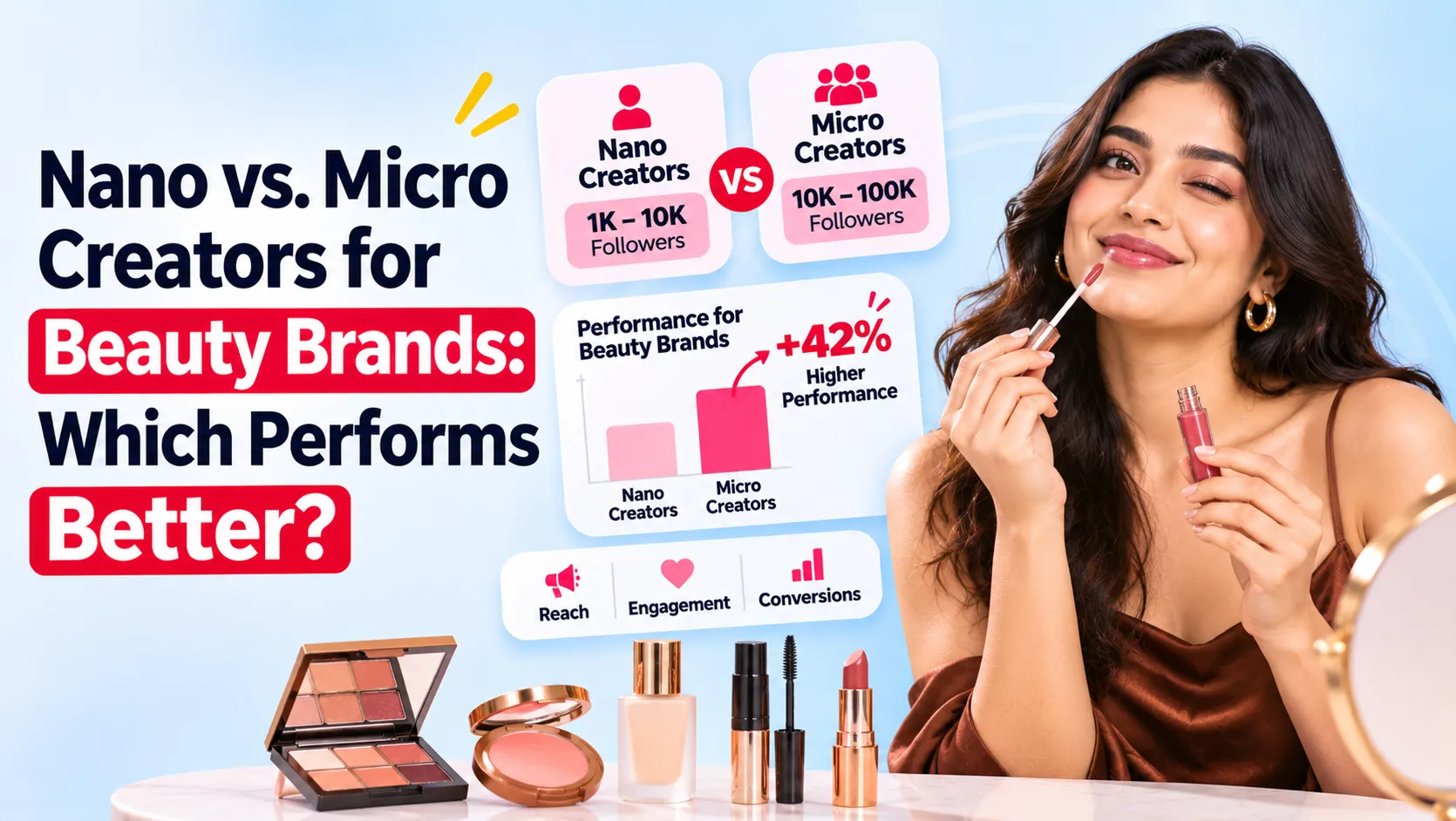
In India's makeup collaborations over the last six months, nano creators (under 10K followers) post a median engagement rate of 1.71%, about 37% higher than micro creators' 1.25%. Micro creators (10K-100K) still win on reach, averaging 171,654 views per post versus 76,128 for nano, roughly 2.3x more. Together, the two tiers power 63.5% of all makeup brand collabs, so the real decision is which metric matters more for the campaign.
Deciding between nano vs micro creators for beauty brands isn't about picking the "better" tier, it's about matching the creator to the job. A nano creator with a small, tightly-knit following and a micro creator with a far larger audience can both post the same lipstick swatch, yet one tends to spark comment-section conversations about shade match and skin type, while the other tends to put the product in front of far more strangers in a single scroll. The right pick depends on which outcome the campaign actually needs right now: believable word-of-mouth from a small, loyal audience, or wider visibility to feed a bigger funnel.
This guide works through six months of real makeup collaboration data, from May to November 2026, to show exactly where each tier pulls ahead, where budgets tend to get wasted, and how brands running both tiers together typically split the work between them. The numbers settle some of the guesswork; the rest comes down to matching the tier to the brief.
Nano vs Micro Creators for Beauty Brands: Key Differences
An influencer marketing agency in India like Grynow can help match the right tier to the right campaign goal using data like this instead of guesswork, since the two tiers behave differently enough that a single default choice rarely fits every brief.
Where the follower lines actually fall
In this dataset, nano creators sit below roughly 10,000 followers and micro creators run from about 10,000 up to 100,000. Beyond that, macro creators (roughly 100,000-1 million) and mega creators (1 million-plus) behave differently again, with far higher reach but noticeably lower engagement rates per view.
What a beauty brand is actually paying for
A nano creator's value is proximity: she talks to a tightly knit audience that often knows her outside Instagram, so a shade recommendation feels personal rather than sponsored. A micro creator's value is production and discoverability: enough followers to show up in Explore and Reels recommendations, plus enough practice to shoot a clean, swatch-heavy makeup tutorial that holds attention past the first three seconds.
Engagement Rate Comparison: Nano vs Micro Creators
Median engagement rate by follower tier (Makeup collabs, last 6 months)
Across 11,004 makeup collaborations analysed, nano creators post the highest median engagement rate of any tier at 1.71%, ahead of micro (1.25%), macro (1.18%) and even mega accounts (1.43%). That 37% gap between nano and micro engagement rates is the clearest argument for nano creators when the goal is comments, saves and genuine product conversation rather than raw impressions.
Methodology
Engagement rate is (likes + comments) divided by views per collab post, reported as medians rather than averages so a handful of viral or boosted posts don't distort the tier figures. Follower tiers are based on the creator's own follower count, not the brand's budget.
Why this happens
Nano audiences are smaller and more self-selected, often people who followed the creator for a specific reason, like shared skin concerns or budget range. That makes them more likely to comment "does this work for oily skin?" or tag a friend, actions that count directly toward engagement rate. Micro creators have outgrown that tight-knit dynamic; their follower base is broader, so a larger share of viewers scroll past without acting.
Reach and Views: Where Micro Creators Pull Ahead
Source: MyWall Genie · 11,004 collabs · 2026-05-06 to 2026-11-02
Micro creators average 171,654 views per collab post against 76,128 for nano, a gap of roughly 2.3x. Median views tell the same story: 12,998 for micro versus 4,346 for nano. For a beauty brand launching a new shade range or trying to reach people who haven't heard of it yet, that difference compounds quickly across a 10-15 creator seeding campaign.
The reach-versus-depth trade-off
Running the math on a hypothetical 20-creator campaign makes the trade-off concrete: 20 nano creators at roughly 76K average views each produce comparable total reach to about nine micro creators, but with a meaningfully higher share of viewers actually engaging. Brands optimising for a launch-week buzz and lots of visible comments should weight toward nano; brands optimising for a new-customer funnel with retargeting ads behind it get more raw eyeballs per rupee from micro.
Real Campaign Patterns Worth Studying
Micro creators scaling an affiliate skincare launch
Both of these posts, from micro-tier creators working with dotandkey.skincare on affiliate collaborations, pulled 51,802,971 views and 50,043,451 views respectively, far above typical micro-tier reach. That scale usually points to paid amplification behind an organic-looking post rather than pure follower reach, a reminder that a single viral number isn't proof a tier "performs better" on its own; it's one data point about one format (here, affiliate links) working unusually well for one brand.
What the pattern suggests for a brand brief
When a micro creator's post massively outperforms their usual average views, ask the brand whether the collaboration included paid boosting or an affiliate push, since that changes what's repeatable. A brand comparing quotes from two micro creators should ask for average organic views, not just their best-ever post, to set realistic expectations.
Repeat Collaborations: Who Beauty Brands Rehire
| Tier | Collabs | Share (%) | Median ER (%) | Avg views | Repeat rate (%) |
|---|---|---|---|---|---|
| nano | 2,628 | 23.9% | 1.71% | 76,128 | 20.5% |
| micro | 4,353 | 39.6% | 1.25% | 171,654 | 18.9% |
| macro | 3,180 | 28.9% | 1.18% | 534,882 | 25.8% |
| mega | 843 | 7.7% | 1.43% | 1,075,064 | 33.7% |
Source: MyWall Genie · 11,004 collabs · 2026-05-06 to 2026-11-02
Repeat rate, how often a brand works with the same creator again, runs lowest for micro creators at 18.9% and highest for mega accounts at 33.7%, with nano close behind mega-adjacent tiers at 20.5%. Mid-sized macro creators sit at 25.8%. For beauty brands, a lower repeat rate among micro creators can mean two things: brands are testing a wide roster of micro talent before committing, or micro-tier results are inconsistent enough that brands keep rotating. Either reading argues for tracking individual creator performance over two or three posts before locking in a long-term retainer.
Which Tier Should Your Beauty Brand Choose?
Choose nano creators when:
- The campaign goal is authentic reviews, UGC content for ads, or seeding before a bigger macro/mega push.
- Budget is limited and the brand wants many distinct voices rather than one big reach number (nano and micro together already account for 63.5% of all makeup collabs, so there's a deep pool to draw from).
- The product needs believable, specific feedback, like a new foundation shade range or a sensitive-skin formula, where comment-section trust matters more than impressions.
Choose micro creators when:
- The brand needs a new product to reach a wider, colder audience quickly, such as a launch week or a festive sale push.
- There's a performance layer (affiliate links, discount codes, paid amplification) that benefits from a creator who already has production polish and consistent posting cadence.
- The brand wants fewer creators to manage per campaign while still beating nano-tier reach by more than double.
The blended approach most brands actually run
Many beauty collaborations in this dataset mix tiers deliberately: a handful of micro creators for reach and discoverability, backed by a larger bench of nano creators for comment-section credibility and content variety. Creators like @saraadiaries_ (8,648 followers, 27.53% engagement rate) and @dreamydelightbyvedanti (2,630 followers, 26.86% engagement rate) illustrate the kind of high-engagement nano accounts worth testing for UGC-heavy briefs, while accounts such as @makeupbyrheanagpal (61,396 followers, 2.22% engagement rate) and @glimglossmakeovers (97,310 followers, 1.48% engagement rate) sit at the upper end of micro, closer to macro-level reach without the macro price tag for a brand's seeding list.
Practical Steps to Run a Nano + Micro Beauty Campaign
- Set the primary metric before outreach. If the brief says "awareness", prioritise micro creators and average views; if it says "trust" or "conversion content", prioritise nano creators and engagement rate.
- Audit the last three posts, not the follower count. A smaller nano account with a high engagement rate, such as @dreamydelightbyvedanti, can be doing more for a brand's comment-section credibility than a larger micro account with a low engagement rate, such as @makeupbyrheanagpal, despite the follower gap between them.
- Separate paid amplification from organic reach in every quote. Ask creators or their managers whether a standout post was boosted; it changes what a brand should expect from future collaborations.
- Budget nano creators for volume, micro creators for a few anchor posts. A common split is a larger creator count in nano for breadth, with the remaining budget on micro creators to carry the campaign's hero content.
- Track repeat-worthy creators across two cycles. Given that micro creators show the lowest repeat rate (18.9%) in this category, treat the first collaboration as a test and only commit to a retainer after seeing consistent engagement, not a single viral spike.
Brands that want to shortlist creators by these exact filters, follower tier, engagement rate, or past brand partnerships can use Grynow's AI-powered influencer marketing platform in India to pull verified creator data instead of relying on media kits alone. For a deeper look at how micro creators specifically are reshaping beauty budgets, see why beauty brands are choosing micro influencers in 2026, and for sourcing tactics, how to find the right beauty influencers for your brand.
Key Takeaways
Nano creators win on engagement rate and cost efficiency per creator; micro creators win on reach and production polish. The two tiers together carry nearly two-thirds of all makeup brand collaborations, which means most successful beauty campaigns aren't choosing one tier exclusively; they're sequencing nano creators for credibility and micro creators for scale, then measuring repeat-worthy performers before committing further budget.
Frequently Asked Questions
Do nano creators really get higher engagement than micro creators in beauty?
Yes. Across six months of makeup collaborations, nano creators post a median engagement rate of 1.71% versus 1.25% for micro creators, a roughly 37% difference, because their smaller, more self-selected audiences comment and save more per view.
Which tier gets more views, nano or micro?
Micro creators average about 2.3x more views per post than nano creators (171,654 versus 76,128 on average), making them the stronger choice when a campaign's goal is reach rather than conversation.
Should a new beauty brand start with nano or micro creators?
New or budget-constrained beauty brands often start with nano creators for authentic, low-cost UGC and comment-section proof, then layer in a few micro creators once the product has early social proof to support a wider push.
Are micro creators more expensive than nano creators for beauty brands?
Generally yes, since micro creators have larger audiences and more production investment, but the data shows that gap is partly justified by roughly double the views per post; the right choice depends on whether the brand needs reach or trust-building engagement.
How many nano vs micro creators should a beauty campaign use?
There's no fixed ratio in the data, but a practical split many brands run is a larger number of nano creators for volume and variety, paired with a few micro creators to anchor reach, since nano and micro together already represent 63.5% of all makeup brand collaborations tracked.