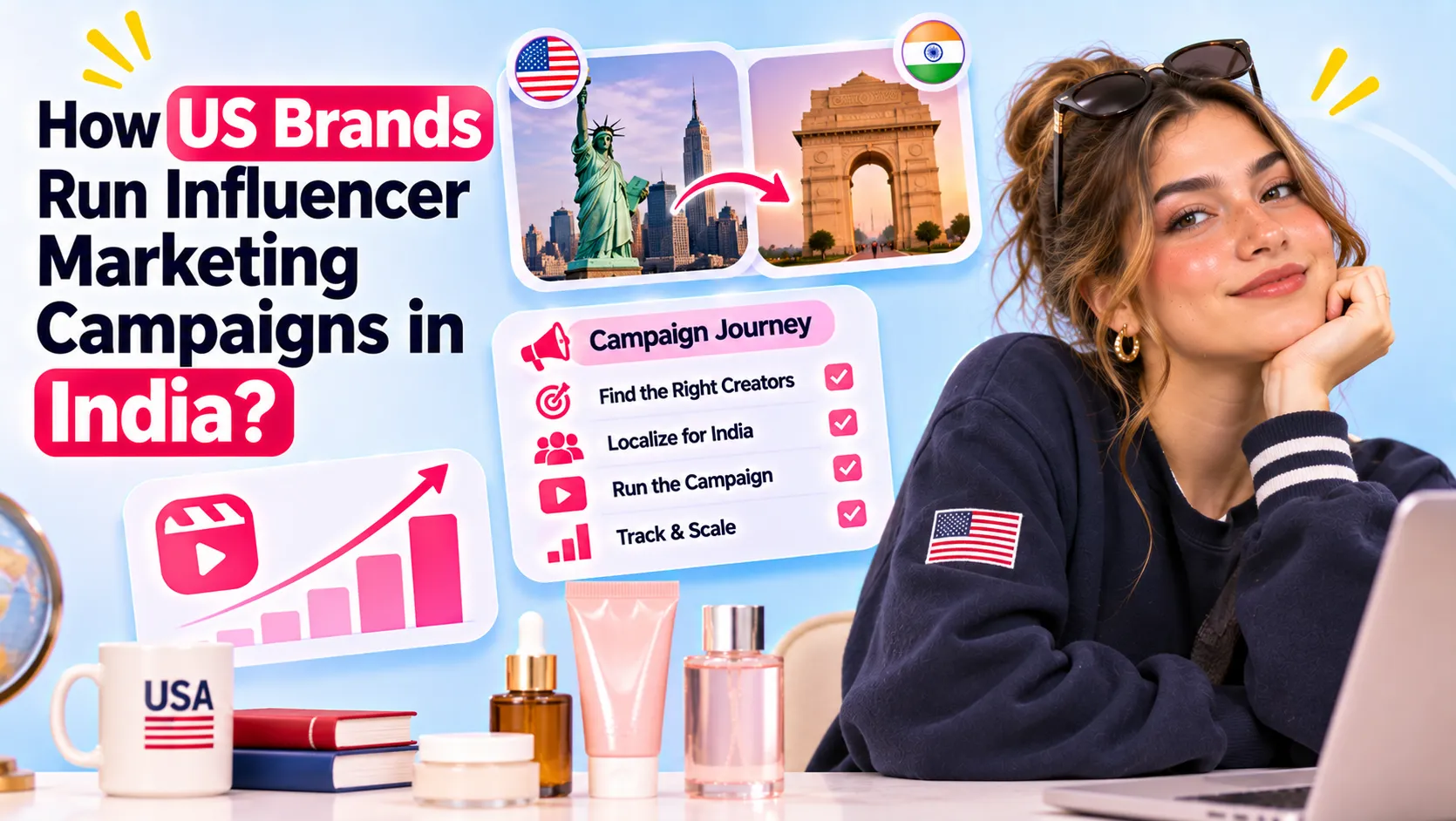
India now has 958 million active internet users, and 588 million of them watch short-form video, according to the IAMAI–Kantar Internet in India Report 2025 (Business Today; YourStory). Rural India accounts for 57% of that base and is growing roughly four times faster than urban India. For a US brand, that is a market larger than the entire US population, reachable mostly through phones and mostly through people they already follow.
Those people are creators. A 2025 study by WPP Media's The Goat Agency and Kantar found that 69% of Indian consumers turn to influencers for information and 63% use them for product discovery (Campaign India).
But a playbook that works in Los Angeles rarely survives the trip to Lucknow. India runs on 22 scheduled languages, sharp price sensitivity, festival-driven buying cycles and a disclosure regime enforced by its own regulators. This guide explains how US brands plan, localize, budget, launch and measure influencer marketing campaigns in India, with two documented examples of American brands that have done it.
Why are US brands investing in influencer marketing in India?
Short answer: creators are the fastest route to trust in a large, fragmented, mobile-first market, and campaigns cost a fraction of US equivalents.
India's influencer marketing industry is still small in dollar terms but growing quickly. Published estimates vary because much of the spend moves directly between brands and creators:
| Source | Estimate | Note |
|---|---|---|
| Kofluence, 2026 report | ₹3,000–3,500 crore in 2025 (about $353–412M) | 22% CAGR; ₹4,500–5,000 crore projected by 2027 |
| The Goat Agency (WPP Media) and Kantar | ₹3,600 crore in 2024 | Forecast to grow 25% in 2025 |
| KlugKlug analysis | Over ₹10,000 crore in actual deployment | Argues ~75% of spend bypasses organised channels |
Four factors make the opportunity specific to international brands:
Reach beyond the metros. Kofluence's 2026 report found creators in Tier 3 and Tier 4 cities account for 43–48% of campaigns and earn 4.5–5.5% engagement, versus 3–4% in metros (Net Influencer).
Cost efficiency. The same report puts Tier 3–4 campaign costs at ₹35,000–90,000 ($410–1,060), compared with ₹3.8–4.5 lakh ($4,470–5,290) in major cities.
Trust gap for new entrants. A US brand with no retail history in India has no word-of-mouth yet. Creators supply that social proof.
Launch leverage. More than 25% of brands surveyed by Kofluence raise influencer spend specifically during product launches.
How is influencer marketing in India different from the US?
Short answer: India has no TikTok, far more languages, lower creator fees, a much larger mid-tier and regional creator base, and its own disclosure rules. US playbooks need to be rebuilt, not translated.
| Factor | United States | India |
|---|---|---|
| Dominant short video | TikTok, Instagram Reels, YouTube Shorts | Instagram Reels and YouTube Shorts (TikTok banned since June 2020); Indian apps such as Moj and Josh in regional markets |
| Platform scale | Instagram ~182M users | YouTube ~500M, Instagram ~481M, Facebook ~403M (Reuters/DataReportal; Statista) |
| Language | Mostly English, plus Spanish | Hindi, English and Hinglish nationally; Tamil, Telugu, Bengali, Marathi, Kannada, Malayalam and others regionally |
| Where growth sits | Saturated urban and suburban audiences | Tier 2–4 towns and rural users, 57% of internet users |
| Creator business maturity | Agents, managers, standard contracts common | Only 10.2% of monetising creators registered as businesses (Kofluence via Net Influencer) |
| Disclosure regulator | FTC Endorsement Guides | ASCI guidelines plus Consumer Protection Act endorsement rules |
| Buying calendar | Black Friday, back-to-school, holidays | Diwali and festive season, wedding season, regional festivals, Amazon and Flipkart sale events |
| Content taste | Polished lifestyle content widely accepted | Raw, relatable content often wins; 49.2% of creators say audiences prefer it |
The practical consequence: a US brand cannot pick five big Instagram names, ship them a brief in English and expect national results. Indian campaigns usually combine a small number of national creators with a larger layer of regional and niche creators.
How can US brands find the right Indian influencers?
Start from the customer, not the follower count. Define which states, cities, languages, income bands and age groups you are selling to, then find creators whose audiences match that profile.
A vetting checklist for Indian creators
Audience geography. Request screenshots of Instagram or YouTube audience insights. A Mumbai creator with 40% of followers outside India is a weak fit for an India launch.
Language of the comments. Comments in Hinglish, Tamil or Marathi tell you more about the real audience than the bio does.
Engagement quality. Look for questions about price, availability and usage, not just emoji replies. Check for sudden follower spikes that suggest purchased followers.
Category credibility. Beauty, tech and personal-finance audiences in India are quick to call out creators who promote everything.
Past brand work. Review how they disclosed previous paid partnerships and whether those posts performed close to their organic average.
Professional readiness. Confirm they can issue an invoice, handle GST where applicable and sign a contract with usage rights.
Regional, national or niche influencers: which should you choose?
Most successful Indian campaigns use all three, in different proportions depending on the goal.
| Creator type | Best for | Strengths | Limitations |
|---|---|---|---|
| National (Hindi/English/Hinglish, often macro or mega) | Launch awareness, brand credibility, PR moments | Pan-India reach, media pickup, fast awareness | Highest fees; engagement often lower; may not move sales outside metros |
| Regional (state-language creators) | Market expansion beyond metros, sales in specific states | High trust, 4.5–5.5% engagement in Tier 3–4 markets, lower cost | Needs native-language briefing and review; more creators to manage |
| Niche (tech, skincare, fitness, parenting, gaming, finance) | Consideration and conversion for specialist products | Expert credibility, detailed reviews, search-friendly YouTube content | Smaller reach; credibility at risk if the brief feels scripted |
A common structure for a first India campaign is one or two national creators for awareness, 10–30 niche creators for credibility, and a regional layer in the two or three states where distribution is strongest. Treat these proportions as a starting point to test, not a fixed rule.
Which platforms work best for influencer marketing in India?
Short answer: Instagram for awareness and short-form reach, YouTube for reviews, long-form trust and search, and selected regional or professional platforms where the audience demands it. In Kofluence's 2026 brand survey, 93.1% of brands prioritized Instagram, 65.5% YouTube and 24.1% LinkedIn (Net Influencer).
| Platform | Primary role in India | Formats that work | Typical fit |
|---|---|---|---|
| Awareness, launches, trend participation | Reels, collab posts, Stories with link stickers | Beauty, fashion, food, lifestyle, D2C | |
| YouTube | Consideration and purchase research | Long-form reviews, unboxings, comparisons, Shorts | Tech, auto, personal care, education, finance |
| B2B credibility and thought leadership | Founder posts, explainers | SaaS, fintech, employer branding | |
| Regional short-video apps (e.g. Moj, Josh) | Reach in non-English markets | Short regional-language video | Mass FMCG, regional campaigns |
| Snapchat | Gen Z reach in cities | AR lenses, creator Stories | Youth fashion, entertainment, beverages |
Instagram vs YouTube for US brands entering India
Use Instagram when the job is to make people notice the brand quickly. Use YouTube when the product needs explaining, costs more than a typical impulse buy, or will be researched before purchase. YouTube videos also keep surfacing in Google search, which gives long-tail value that a 24-hour Story does not.
Short-form video carries the most commercial weight: 84.4% of Indian creators in the Kofluence survey named Reels and Shorts as their highest-earning format.
How to plan and execute an influencer marketing campaign in India: a 9-step framework
This framework assumes a US brand running its first or second campaign in India, typically over 8–12 weeks.
- Set one primary objective. Awareness, consideration, app installs or sales. Mixing all four in a first campaign makes results impossible to read.
- Map the market. Decide which states and cities matter, based on where your product is actually available (Amazon, Flipkart, Nykaa, Myntra, quick commerce apps, or your own site).
- Localize the proposition. Confirm India pricing, delivery timelines, returns and customer support before any creator goes live. Indian audiences ask about price and availability in the comments within minutes.
- Build the creator mix. Combine national, niche and regional creators as described above, and shortlist 1.5–2x the number you need, since availability and pricing will narrow the list.
- Write a flexible brief. Give creators the must-say claims, the do-not-say list and the disclosure requirement, then let them script in their own voice and language.
- Contract properly. Cover deliverables, timelines, approval rounds, exclusivity, content usage rights for paid ads, payment terms and tax documentation.
- Review before posting. Check claims, disclosure placement and translations. For regional content, use a native speaker on your side, not machine translation.
- Amplify the best performers. Boost top posts through Instagram partnership ads or YouTube ads, and repurpose approved content on your own channels and marketplace listings.
- Measure and iterate. Compare creators on cost per engagement, cost per view and attributable sales, then move budget toward the formats and regions that work.
Launching a product in India through influencers
Product launches are where influencer spend spikes most. For a US brand, a launch typically runs in three waves: a teaser phase with seeded products and unboxings two to three weeks before availability, a launch-week burst with national creators and live links, and a sustain phase of niche reviews and regional content over the following four to eight weeks.
The common failure is a creator burst that lands before marketplace listings, stock or delivery are ready. Brands that lack local launch operations often work with a product launch agency in India to coordinate creator timing with distribution, PR and marketplace readiness.
How much does influencer marketing cost in India?
Short answer: far less per creator than in the US, but a well-run India campaign needs more creators, more languages and more coordination. Kofluence reports that a typical influencer-led e-commerce campaign costs brands ₹8–14 lakh, roughly $8,300–14,500 (Apparel Resources).
Indicative creator pricing in India (Instagram Reels)
| Creator tier | Followers | Indicative fee per Reel | Source |
|---|---|---|---|
| Nano | Under 10K | ₹500–5,000 (about $6–60), often partly barter | Kofluence 2025 via Storyboard18 |
| Micro | 10K–100K | Published agency benchmarks range from about ₹5,000 to ₹80,000 | Varies widely by niche and engagement |
| Mid-tier and macro | 100K–1M | Roughly ₹50,000 to several lakh | Most negotiable tier |
| Mega and celebrity | 1M+ | ₹2 lakh upward (about $2,300+), often far higher | Kofluence 2025 via Storyboard18 |
USD figures are approximate. Treat every range as a starting point for negotiation, not a rate card. For a fuller tier-by-tier breakdown, including YouTube rates, see this guide to influencer marketing cost in India.
What changes the price
Category. Finance, tech and beauty creators with proven conversion charge a premium.
Usage rights. Fees rise when you want to run creator content as paid ads or on marketplace listings, and rise again for longer periods.
Exclusivity. Blocking a creator from working with competitors for 30–90 days costs extra.
Season. Rates and availability tighten before Diwali and during major e-commerce sale events, so book early.
Format. A dedicated YouTube review costs more than a Reel because of production time.
What budget should a US brand plan for its first India campaign?
As a planning heuristic, many first campaigns sit between the ₹8–14 lakh range above and a few times that if they include national creators. Reserve 15–25% of the creator budget for paid amplification of the best-performing content, and budget separately for product seeding, shipping and agency or platform fees.
How should US brands localize influencer campaigns for Indian consumers?
Localization in India means more than translation. It covers language, price framing, cultural references and the occasions when people buy.
Language: write for Hinglish first, then go regional
Urban national creators often speak Hinglish, a fluid mix of Hindi and English. In the South, West and East, regional languages carry far more trust. Kofluence's 2026 report quotes an Emami marketer warning that briefing a large lifestyle creator and adding a regional voiceover misses the point, because small regional creators are trusted like family (Net Influencer). Brief regional creators in their language, or through a native-speaking campaign manager.
Price and value framing
Indian consumers compare prices aggressively and expect creators to address them. Content that explains price per use, long-term value, warranty, local service or EMI options performs better than content that only shows the product. If your India price is higher than the US price after duties, prepare creators to answer that question honestly.
Cultural relevance and the festive calendar
Plan around Diwali and the wider festive quarter, wedding season, and regional festivals such as Onam, Durga Puja, Pongal and Ganesh Chaturthi.
Cricket moments, Bollywood and regional film releases are reliable hooks for topical content.
Family and community framing often lands better than individualistic messaging.
Avoid humour or imagery touching religion, caste, regional stereotypes or politics. A joke that reads as harmless in the US can trigger a boycott call in India.
Product and offer localization
Check shade ranges for beauty products, sizing for apparel, voltage and plug types for electronics, and dietary claims for food. Confirm whether cash on delivery, local return policies and Indian customer support are available, because creators will be asked.
What legal rules apply to influencer marketing in India?
Short answer: every paid, gifted or otherwise material relationship must be disclosed clearly and upfront, claims must be substantiated, and both the brand and the creator can be penalised. Two layers apply.
| Layer | What it is | Key requirement |
|---|---|---|
| ASCI Guidelines for Influencer Advertising (2021, since updated) | Self-regulatory code from the Advertising Standards Council of India | Upfront labels such as Ad, Sponsored, Collaboration or Partnership; not hidden among hashtags; superimposed on picture- or video-only content (LiveLaw) |
| Department of Consumer Affairs, Endorsements Know-hows! (January 2023) | Government guidance under the Consumer Protection Act, 2019 | Disclose any material connection, in the same language as the endorsement; disclosures must be hard to miss (Business Standard) |
Penalties
The Central Consumer Protection Authority (CCPA) can fine manufacturers, advertisers and endorsers up to ₹10 lakh for a false or misleading advertisement, and up to ₹50 lakh for later violations. It can also bar an endorser from endorsing for up to one year, or three years for repeat violations (Business Standard). When the guidelines were announced, ASCI said influencer violations made up almost 30% of the ads it took up (afaqs).
Compliance checklist for US brands
Write the disclosure requirement, label wording and placement into every contract and brief.
Treat free products as material connections; gifted posts need disclosure too.
Substantiate claims. Creators are expected to have used or verified what they endorse.
Take extra care in regulated categories. Finance creators face SEBI scrutiny, and health, food and cosmetics claims attract regulator attention.
Handle personal data carefully. India's Digital Personal Data Protection Act applies to brands and creators collecting Indian user data, for example through contests or lead forms.
Check tax obligations with an Indian adviser, including withholding (TDS) on creator fees and on high-value gifted products.
If your team follows FTC rules in the US, the principles will feel familiar. The differences are the specific label wording, the same-language requirement and India-specific penalties. This section is general information, not legal advice.
How do US brands measure influencer campaign ROI in India?
Short answer: match each metric to the campaign objective, track every creator with unique links or codes, and compare cost efficiency across creators rather than judging total reach. Measurement is still maturing in India: only 13.3% of brands in Kofluence's 2026 survey tie influencer marketing directly to revenue targets, while 46% link it to performance metrics on at least some campaigns (Net Influencer).
| Objective | Primary metrics | How to track |
|---|---|---|
| Awareness | Reach, views, cost per 1,000 views, share of voice | Creator insight screenshots or API access, social listening |
| Engagement | Engagement rate, saves, shares, comment sentiment | Platform analytics, comment review in local languages |
| Traffic | Clicks, cost per click, landing page sessions | UTM-tagged links per creator |
| Sales | Orders, revenue, cost per acquisition, ROAS | Unique discount codes, marketplace affiliate or attribution links where available |
| App growth | Installs, cost per install, day-7 retention | Mobile measurement partner links per creator |
| Brand lift | Awareness and purchase-intent change | Pre- and post-campaign surveys or platform brand-lift studies |
Practical measurement tips
Agree reporting format and deadlines in the contract, including screenshots of reach and audience data seven days after posting.
Read comments in the creator's language. Sentiment and purchase questions are often in Hindi, Tamil or Hinglish, not English.
Allow for marketplace leakage. Many Indian shoppers see a creator post and then search the product on Amazon or Flipkart, so direct-link attribution undercounts sales.
Compare creators on cost per engagement and cost per acquisition, then reinvest in the top 20–30%.
Real examples: how two US brands use Indian creators
Both examples below are drawn from published trade-press coverage. Verified facts are cited; the "lessons" are our strategic analysis, not claims made by the brands.
Example 1: Netflix India, creator-led title launches
Market presence. California-based Netflix launched in India in 2016 and markets a mix of Indian originals and global titles. In a May 2024 interview, Netflix India marketing VP Srivats TS said the brand had an organic social community of 44 million fans.
Creator approach (verified). Per the same interview:
Influencer marketing is a key part of Netflix's India strategy, with comedians and creators such as Tanmay Bhat, Samay Raina and Prashasti Singh promoting titles on YouTube.
Creators are matched to each title's essence and target audience. For a female-oriented title, Netflix works with creators whose following is predominantly female.
The influencer strategy is explicitly meant to reach audiences beyond Netflix's existing demographic by feeling more local, relatable and accessible, while keeping its global brand credentials.
Pre-launch activity focuses on building anticipation; post-launch activity responds to audience sentiment and organic traction.
For Wednesday Season 2 in 2025, Netflix India gave five Indian creators, including Ankush Bahuguna and Apoorva Mukhija (The Rebel Kid), access to cast interviews with Jenna Ortega, Emma Myers and Gwendoline Christie, plus immersive events, for branded content shared on Netflix India's Instagram. Exchange4media reported both seasons reached Netflix India's Top 10; it did not attribute that ranking to creators alone.
Platforms and creator types. YouTube and Instagram; comedians, pop-culture commentators, fashion and lifestyle creators.
Lessons for other US brands (analysis).
Pick creators per product or audience segment, not one roster for everything.
Give creators access, not just scripts. Exclusive interviews and events produce content creators want to post.
Use creators to localize a global brand without diluting it.
Example 2: Crocs, seasonal campaigns built around Indian creators
Market presence. Colorado-based Crocs runs India-specific marketing through its @crocsindia channels and has localized its global creative platforms for India, including India-exclusive Jibbitz charms.
Creator approach (verified).
| Date | Campaign | Creators and talent | Source |
|---|---|---|---|
| 5 Oct 2026 | Feel It All, festive season | Cricketer KL Rahul (global brand ambassador), actor Dalip Tahil, creators Rida Tharana and Prish, internet-famous bodyguard Amin Khan; rollout across digital, social, influencer and retail with creator collaborations and festive gifting | afaqs! |
| Mid-2026 | Wonderfully Unordinary, monsoon | Actor Rashmika Mandanna with creators Swayam Siddhi, Kevin Zhingkai, Krithi and Aryan Katoch | Storyboard18 |
| Mid-2024 | Splash Your Style, monsoon | Dance crew Quick Style with creators Shantanu Maheshwari, Ruhee Dosani, Sheetal Perry and Aakash Thapa, set to a version of Ritviz's "Barso"; aimed at Gen Z | BuzzInContent |
On the festive campaign, Crocs APAC SVP and general manager Varun Sehgal described India's festive season as a key business moment. Crocs has not published sales or engagement results for these campaigns, so we do not cite any.
Platforms and creator types. Instagram-first, social-first films; dance, fashion, lifestyle and comedy creators paired with a celebrity anchor.
Lessons for other US brands (analysis).
Adapt the global platform to Indian moments. Crocs tied campaigns to the monsoon and festive season, two of India's strongest seasonal hooks.
Pair one celebrity anchor with several creators. The celebrity gives reach; creators add relatability and native content formats.
Plan the full funnel. The festive campaign connected the creator film with gifting, retail and a festive product capsule.
Common mistakes international brands make in India
Treating India as one market. A campaign built for Mumbai and Delhi will underperform in Chennai, Kolkata or Indore.
Translating instead of localizing. Dubbed or subtitled US creative rarely feels native. Let Indian creators build the content.
Choosing creators on follower count. Inflated followers and engagement pods are common. Verify audience data before signing.
Launching before distribution is ready. Creator buzz without stock, marketplace listings or delivery coverage wastes budget and damages trust.
Ignoring price questions. If creators cannot explain why the product is worth its Indian price, comments will fill with objections.
Weak disclosure. A hashtag buried at the end of a caption does not meet ASCI expectations.
Running one-off posts only. Kofluence found 47.1% of creators strongly prefer ambassador-style deals, and most brands surveyed agreed long-term partnerships deliver better ROI (Net Influencer).
Slow approvals from the US. Time-zone gaps and multi-layer approvals miss trend windows. Agree a fast approval path before launch.
How to choose an influencer marketing agency in India
Most US brands enter India without a local marketing team, an Indian entity that can contract creators, or relationships with regional talent. An experienced influencer marketing agency in India fills those gaps: creator discovery and vetting, negotiation in local currency, multilingual content review, compliance, payments and reporting.
Questions to ask before you hire
| Question | What a good answer looks like |
|---|---|
| Which international brands have you run India campaigns for? | Named clients or detailed case studies with objectives, creator mix and results |
| How do you verify creator audiences? | Audience-insight screenshots or platform data, fake-follower checks, past performance review |
| Which languages can your team review in-house? | Native reviewers for the regions in your plan, not only Hindi and English |
| How do you handle ASCI and CCPA compliance? | Disclosure clauses in contracts, pre-publication checks, a clear process for takedowns |
| How are fees structured? | Transparent split between creator fees, management fee and amplification spend |
| What will reporting include? | Creator-level metrics tied to your objective, in a format your US team can use |
| Who owns the content and usage rights? | Clearly negotiated rights for paid ads and marketplace use, with defined durations |
Red flags include guaranteed virality, refusal to share creator-level data, and pricing that bundles creator fees and agency margin into one opaque number.
Conclusion: practical recommendations for your first India campaign
India rewards US brands that treat influencer marketing as a localization exercise, not a media buy. Netflix and Crocs show the pattern: match creators to specific audiences, adapt global platforms to Indian moments, and give creators room to speak in their own voice.
For a first campaign:
Start narrow. Pick two or three states and one primary objective.
Fix the basics first. Pricing, availability, delivery and support must be live before creators post.
Build a layered roster. A few national names, a core of niche experts and a regional layer where you sell.
Contract for compliance and rights. Upfront disclosure, claim substantiation and paid-usage rights in every agreement.
Measure by creator. Use unique links and codes, then reinvest in what works.
Think in seasons, not posts. Plan around festivals and sale events, and convert top performers into longer partnerships.
The biggest variable is execution on the ground. Choosing a local partner that understands Indian creators, languages and regulation will shape results more than any single creator choice.
FAQs: influencer marketing in India for US brands
Can a US brand run influencer campaigns in India without an Indian entity?
Yes. Many brands run campaigns through an Indian agency or platform that contracts and pays creators locally. You will still need a way for Indian customers to buy, such as a marketplace listing, a distributor or an India-ready website.
How much should a US brand budget for a first influencer campaign in India?
Kofluence reports a typical influencer-led e-commerce campaign in India costs ₹8–14 lakh (about $8,300–14,500). Campaigns with national celebrities or many regions cost more. Add 15–25% for paid amplification.
Is Instagram or YouTube better for influencer marketing in India?
Instagram is the default for awareness and launches; 93.1% of brands surveyed by Kofluence prioritize it. YouTube is stronger for considered purchases such as tech, auto and finance, because detailed reviews keep ranking in search.
Is TikTok available in India?
No. TikTok has been banned in India since June 2020. Instagram Reels and YouTube Shorts lead short-form video, with Indian apps such as Moj and Josh in regional markets.
Do Indian influencers have to disclose sponsored posts?
Yes. ASCI guidelines and the Department of Consumer Affairs' Endorsements Know-hows! require clear, upfront labels such as Ad, Sponsored or Collaboration, in the same language as the content. Penalties under the Consumer Protection Act can reach ₹10 lakh, and ₹50 lakh for repeat violations.
Should US brands work with regional-language influencers?
Yes, if you sell beyond the major metros. Kofluence data shows Tier 3–4 creators deliver 4.5–5.5% engagement at much lower cost than metro creators.
How long does it take to launch an influencer campaign in India?
Plan 8–12 weeks for a first campaign: two to three weeks for strategy and creator shortlisting, two to three for contracting and content, and four to six weeks of live activity and optimization.
How do I measure sales from Indian influencer campaigns?
Give each creator a unique discount code and tracked link, use marketplace affiliate or attribution links where available, and compare cost per acquisition across creators. Expect some sales to happen through marketplace search rather than direct clicks.