Quick answer
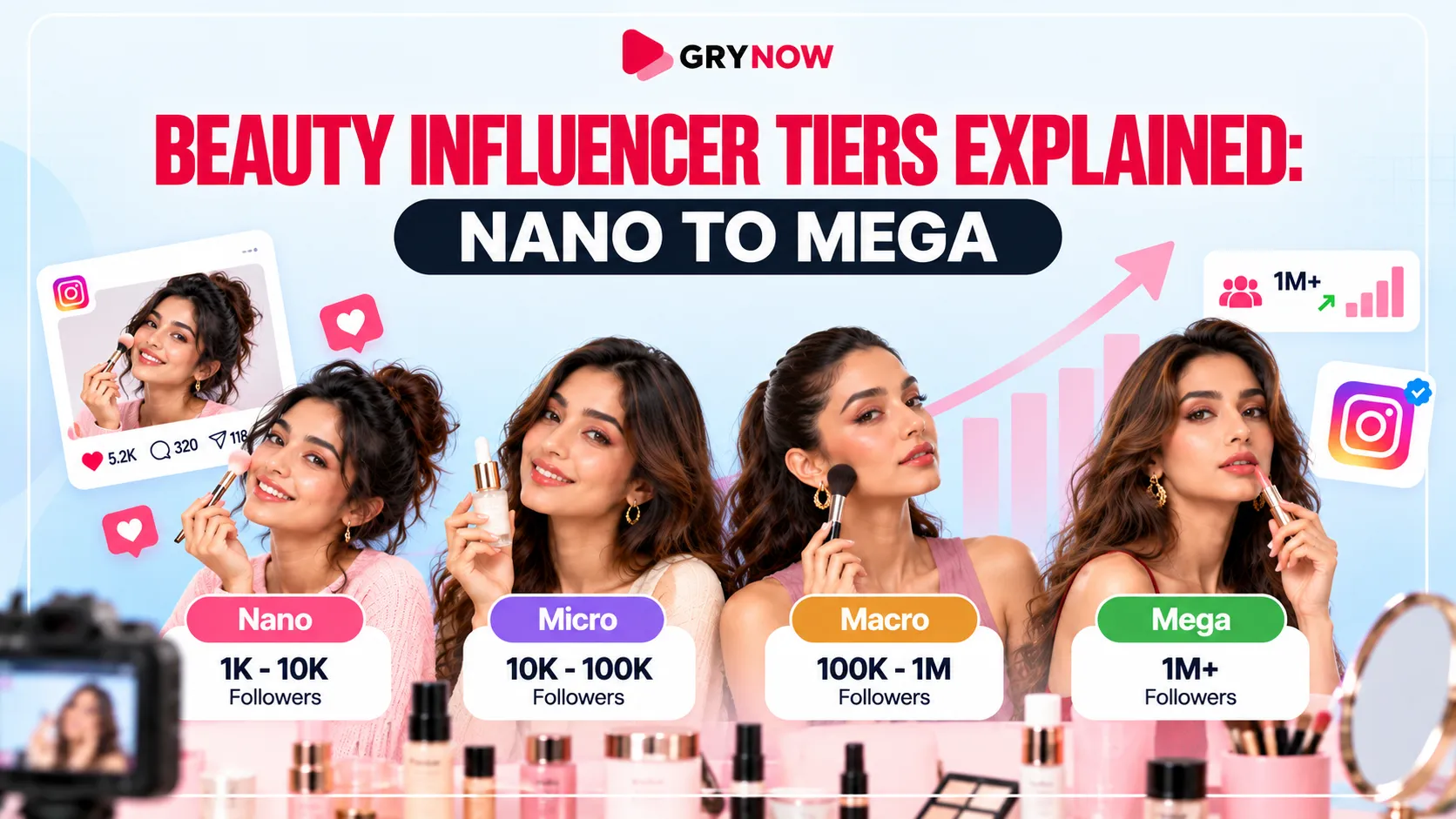
Beauty influencer tiers are grouped by follower count: nano (1K–10K), micro (10K–100K), macro (100K–1M) and mega (1M+). Across 10,000 Makeup collaboration posts analysed over a recent six-month window, nano and micro creators together carried 63.4% of all collabs, and median engagement rate fell from 1.69% at nano to 1.17% at macro before climbing back to 1.43% at mega.
Why Beauty Influencer Tiers Matter Right Now
"Influencer" is not one audience size in beauty; it is at least four distinct kinds of media, each with its own reach, cost logic and content feel. A bridal makeup artist with a modest, local following and a national beauty entertainer with a following well into seven figures are both "influencers," but a brand manager who treats their Reels as interchangeable is comparing a conversation to a broadcast. Getting the beauty influencer tiers straight before you look at a single rate card changes what you should realistically expect from a post: reach, engagement, tone, and how much creative control the creator keeps.
This matters more in a market this crowded. In the Makeup collaboration data pulled for this piece, 4,579 individual creators worked with 227 brands across 10,000 posts in six months and that is one beauty subcategory. For brands planning campaigns across different creator tiers, working with an experienced influencer marketing agency in India can help align creator selection with campaign goals, audience fit and budget.
Beauty Influencer Tiers at a Glance
| Tier | Follower range | Typical content feel | Visibility pattern | |---|---|---|---| | Nano | 1K – 10K | Personal, unscripted, single-product focus | Narrow reach, high relatability | | Micro | 10K – 100K | Tutorials, routines, product reviews | Steady niche reach | | Macro | 100K – 1M | Polished GRWMs, brand campaigns, series content | Broad reach, more production value | | Mega | 1M+ | Entertainment-first, launches, high-profile tie-ins | Mass, broadcast-style reach |
Source: MyWall Genie · 10,000 collabs (most recent) · 2026-05-14 to 2026-10-26
Methodology
Figures on this page come from Makeup-category collaboration posts over a six-month window (mid-May to late October). Engagement rate is (likes + comments) ÷ views per post; tier medians, not averages, are used so a handful of viral posts don't distort the picture; tiers are assigned from the creator's follower count.
Nano Influencers: Small Audiences, Close Conversations
Nano influencers sit in the 1K–10K follower band, and in the makeup data they post the smallest average views of any tier, around 73.7K per collab, but the highest median engagement rate, at 1.69%. That combination is the whole case for this tier: fewer eyeballs, but a bigger share of the people watching actually comment or like.
@pm_makeup_artistry is a nano-tier example from the beauty niche in the data: a bridal makeup specialist with 10,000 followers, a 0.68% engagement rate and close to 3K average views per post. That single account sits below the tier's 1.69% median, which is a useful reminder that tier medians describe a pattern across thousands of posts, not a guarantee for any one account. Brands typically use nano creators for seeding, localised or regional audiences, and low-cost volume rather than mass awareness.
Micro Beauty Influencers: The Everyday Workhorse Tier
Micro beauty influencers run from 10K to 100K followers and are the single biggest group in the makeup dataset, 39.8% of all 10,000 collabs analysed, more than any other tier. Their median engagement rate (1.26%) sits between nano and macro, and their average views (165K) are roughly double nano's.
@makeupbyrheanagpal illustrates the tier: 61.4K followers, a 2.22% engagement rate, and close to 37.9K average views, posting makeup and hair content. Volume is the draw here; enough creators exist at this size that brands can run many parallel collaborations (tutorials, "get ready with me" formats, dupe comparisons) without relying on one or two big names.
Macro Influencers: Where Reach Starts Compounding
Macro influencers (100K–1M followers) make up 29.1% of makeup collabs in the data, and this is where average views jump sharply to about 500K per post, roughly three times micro's average. Median engagement rate dips to its lowest point here, 1.17%, which is a normal trade-off as audiences grow larger and less personally connected to any one creator.
Two examples from the data show the range within this tier: @rena_goswami_ at 354K followers with a 2.05% engagement rate and around 594K average views, and @vaishnaviwahi at 123.6K followers with a 2.17% rate and roughly 56.1K average views. Both sit above the tier's 1.17% median, which is the kind of spread brand teams should expect macro is a wide band, and a creator near its lower edge behaves differently from one near its top.
Mega Influencers: Mass Visibility, Broadcast-Style Reach
Mega influencers cross 1M followers and are the smallest group by volume, just 7.5% of makeup collabs, but they post the highest average views (close to 997K) and, notably, engagement rate ticks back up to 1.43%, above both micro and macro. They also show the highest repeat collaboration rate of any tier, 33.6%, about 1.7 times nano's repeat rate.
@the_game_of_makeup (1.73M followers, 1.5% engagement rate, roughly 722K average views) and @pratiksha_thorat52 (1.25M followers, 1.45% engagement rate, about 951K average views) sit at this tier. The pattern across both suggests mega creators in beauty function less like reviewers and more like entertainment channels that beauty brands return to for visibility at launch moments.
Engagement and Reach by Tier: What the Data Actually Shows
Median engagement rate by follower tier
Average views by follower tier
| Tier | Collabs | Median ER (%) | Avg views | Repeat rate (%) |
|---|---|---|---|---|
| nano | 2,364 | 1.69% | 73,730 | 20.1% |
| micro | 3,976 | 1.26% | 165,037 | 19.2% |
| macro | 2,909 | 1.17% | 500,148 | 25.8% |
| mega | 751 | 1.43% | 996,726 | 33.6% |
Source: MyWall Genie · 10,000 collabs (most recent) · 2026-05-14 to 2026-10-26
Two things stand out once the tiers are laid side by side. First, engagement rate doesn't fall in a straight line as follower count rises; it dips through micro and macro, then recovers at mega, a U-shape rather than a steady decline. Second, the climb in views is steep: mega's average views are about 13.5 times nano's, while macro's are about 3 times micro's. Reach scales much faster than engagement does, which is exactly why "bigger audience" and "more engaged audience" are two separate questions, not one.
Views Aren't the Same as Engagement: Three Posts Across Tiers
Beauty collab posts across tiers
These three posts, pulled from the same six-month makeup dataset, make the point concretely. A micro-tier post (47.3K followers) pulled in 51.8M views for a skincare-brand tag; a macro-tier post (433K followers) reached 90.5M views on an affiliate collaboration; a mega-tier post (1.7M followers) reached 75.9M views on a collaborative post. None of these posts' per-post engagement rates match their tier's typical median; they're outliers that went unusually wide, which is a good reminder when reading this kind of data: a single view count is one data point, not proof of what a tier normally delivers. Use tier medians for expectations and treat any one viral post as exactly that — one post.
How Brand Collaborations Vary Across the Market
| Collab Type | Collabs | Share (%) | Median ER (%) | Repeat rate (%) |
|---|---|---|---|---|
| tagged | 4,813 | 48.1% | 1.3% | 28.4% |
| collaborative | 4,809 | 48.1% | 1.38% | 15.4% |
| affiliate | 378 | 3.8% | 1.45% | 13.7% |
Source: MyWall Genie · 10,000 collabs (most recent) · 2026-05-14 to 2026-10-26
Across the full makeup sample, tagged posts and collaborative posts are almost evenly split (48.1% each), with affiliate arrangements a small minority at 3.8%. Collaborative posts carry noticeably higher average views than tagged ones, while affiliate posts, despite being rare, post the highest median engagement rate of the three types. Brand names active across this dataset span the expected mix of cosmetics and makeup players, from mass retail names to specialist makeup labels, underscoring that beauty influencer tiers aren't exclusive to one kind of brand or budget size; the same follower bands show up whether the collaborator is a drugstore cosmetics brand or a skincare label crossing into makeup content.
Tier Is a Lens, Not a League Table
None of this makes one tier objectively "better." A nano creator's 1.69% median engagement and a mega creator's near-997K average views are both real strengths; they just answer different questions. The brief for a hyperlocal bridal campaign and the brief for a national product launch shouldn't default to the same tier just because it previously "worked." Treat the tier as a first filter on reach versus relatability, then let your specific goal, category (makeup, skincare, cosmetics or otherwise) and budget decide where on the nano-to-mega spectrum to look next.
Frequently Asked Questions
What follower count counts as a nano influencer in beauty?
In this analysis, nano influencers are creators in the 1K–10K follower band. They carried 23.6% of the 10,000 makeup collaboration posts analysed and posted the highest median engagement rate of any tier, 1.69%.
Do micro influencers really have higher engagement than macro influencers?
In the makeup data, yes on a median basis: micro creators (10K–100K followers) posted a 1.26% median engagement rate versus 1.17% for macro creators (100K–1M followers). The gap is a few tenths of a percentage point, not a dramatic difference, and individual creators vary widely on either side of it.
How much bigger is the reach of a mega influencer versus a nano influencer?
Mega influencers (1M+ followers) averaged about 997K views per makeup collab post versus roughly 73.7K for nano influencers, close to 13.5 times more reach on average, based on the six-month sample analysed here.
Which beauty influencer tier gets the most repeat brand work?
Mega influencers showed the highest repeat collaboration rate among the four tiers at 33.6%, followed by macro at 25.8%. Nano and micro sat lower, at 20.1% and 19.2% respectively.
Is engagement rate calculated the same way for every tier?
Yes, in this data, engagement rate is always (likes + comments) divided by views on a given post, and tier figures are reported as medians rather than averages so a few unusually viral posts don't skew the typical picture for that tier.