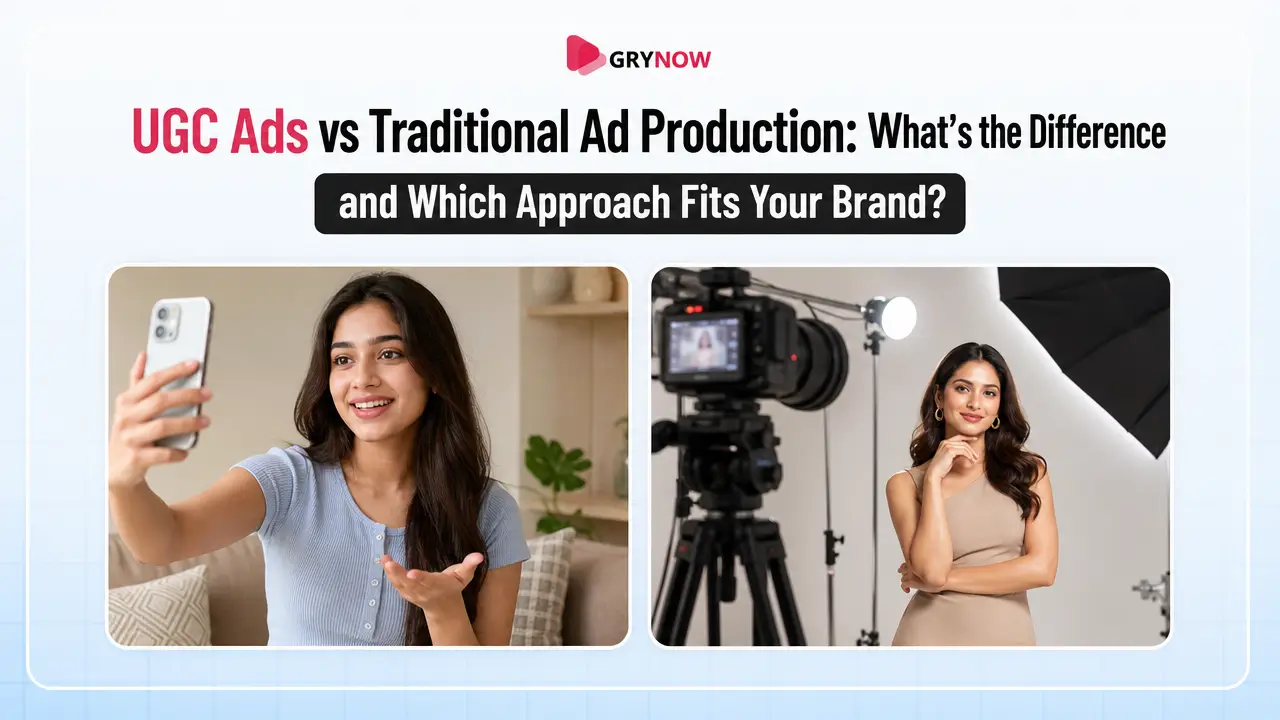
Why Performance Brands Are Rethinking Ad Production
If you run paid media for a living, you've probably noticed the same pattern: a competitor's ad shows up in your feed, it looks like it was shot on someone's phone, and it's clearly working because it keeps showing up. Meanwhile, your last studio shoot took six weeks to plan, cost a meaningful chunk of your quarterly budget, and produced maybe four usable ad variants.
This is the tension driving brands to rethink ad production right now. Traditional ad production, agency-led shoots, studio sets, professional talent, and multi-week post-production, was built for a media environment where a handful of polished ads ran for months. Performance marketing doesn't work that way anymore. Algorithms reward creative variety, audiences fatigue on the same ad within days, and the winning ad is rarely the most expensive-looking one. It's the one that gets the hook, the pacing, and the authenticity right.
UGC ads, creative that looks and feels like organic, creator-shot content even when it's produced for paid media, fit this environment because they're cheaper to make in volume, faster to turn around, and often blend into a feed instead of interrupting it. That's not a stylistic preference; it's a structural advantage for brands that need to test constantly. The shift isn't about abandoning production quality altogether. It's about matching your production model to how performance advertising actually works today: test many things fast, kill what doesn't work, scale what does.
UGC Ads vs. Traditional Production: The Core Differences
Before deciding whether to switch, it helps to see the two approaches side by side on the dimensions that actually affect a performance marketer's day-to-day work.
| Dimension | UGC Ads | Traditional Ad Production |
|---|---|---|
| Production setup | Creator films on phone, often at home or in-context | Studio, set design, crew, professional lighting |
| Turnaround | Days | Weeks |
| Cost per creative | Low, scales with number of creators/videos | High, largely fixed per shoot day |
| Creative volume | Many variants per campaign | Few variants per campaign |
| Visual style | Native, unpolished, feed-native | Polished, branded, high production value |
| Best suited for | Performance/direct-response campaigns, product videos, iterative testing | Brand campaigns, TV/OOH, high-stakes launches |
| Iteration speed | Fast: swap hooks, creators, angles quickly | Slow: reshoots are expensive and time-consuming |
The core difference isn't just aesthetic. Traditional production optimizes for a small number of "perfect" assets that need to work for a long time across many channels. UGC ads optimize for volume and speed, treating creative as something you test and iterate on rather than something you commission once and run for a quarter. Product videos are a good example of where this plays out concretely: a traditional product video is typically one polished asset built to last; a UGC approach might produce ten different product videos from different creators, testing different demonstrations, hooks, and framings against each other.
Cost: Why UGC Ads Are Cheaper to Produce at Scale
The cost gap between UGC and traditional production comes down to what you're actually paying for. A traditional shoot bundles location, crew, equipment rental, talent, and post-production into a single fixed cost that doesn't flex much whether you need one ad or five. A UGC creative, by contrast, is priced closer to a single creator's time and editing, which means the cost per creative stays relatively flat as you scale up the number of assets you produce.
This is why "UGC is cheaper" understates what's actually happening. The more accurate statement is that UGC changes the cost curve: instead of a large upfront production budget that yields a handful of assets, you get a production model where cost per creative drops as volume increases, because you're not re-paying for sets, crews, and studio time each time. For a performance marketer running constant creative tests across multiple ad accounts and audiences, that difference compounds. A budget that might have funded one traditional shoot can often fund a much larger batch of UGC-style videos, giving you more raw material to test hooks, angles, and messaging against real audience response instead of internal opinion.
It's worth being precise here rather than promotional: exact savings depend heavily on your market, the number of creators involved, and how much editing and paid usage rights you're licensing. But the structural direction is consistent across performance teams that have made the switch: lower cost per individual creative, and more creative volume for the same total production budget.
Speed: Turnaround Time from Brief to Live Ad
Traditional ad production timelines are shaped by everything that has to happen before a single frame is shot: creative concepting, location scouting, casting, crew scheduling, the shoot itself, and then editing and revisions. Even a straightforward shoot commonly stretches across several weeks from brief to final delivery, and any reshoot or change of direction adds more time on top of that.
UGC production compresses most of that. There's no location to book, no crew to coordinate, and often no set to build, a creator films in their own environment on their own equipment. Briefs can go out and come back as finished footage within days rather than weeks, and editing turnaround is typically much shorter because the raw footage doesn't need the same level of color grading, sound design, or multi-camera assembly.
Speed matters for performance marketing specifically because creative testing is iterative by nature. If it takes six weeks to get a new ad variant, you're testing four to five ideas a year at best, and each one is a significant bet. If it takes a few days, you can test dozens of hooks, formats, and angles in the same window, let the data tell you what's working, and reallocate budget accordingly. In an environment where ad fatigue can set in within days on a given creative, the team that can refresh creative fastest usually wins the efficiency race, regardless of how polished any single ad looks.
Performance: Do UGC Ads Actually Convert Better?
UGC-style ads often outperform traditional polished ads on click-through rate and conversion, primarily because they look native to the platform and read as recommendations rather than advertisements. That's the direct answer, but it deserves a caveat: "UGC performs better" isn't a universal law, it's a pattern that shows up specifically in performance and direct-response contexts, particularly on platforms like Meta and TikTok where feed-native content already sets the visual expectation for what an ad should look like.
The mechanism behind this is fairly well understood among performance marketers: a highly produced ad signals "advertisement" the moment it appears, which primes viewers to scroll past. A UGC-style ad, especially one that opens with a creator talking directly to camera or demonstrating a product in a real setting, mimics the content people are already scrolling through for entertainment or advice, so it earns a beat longer of attention before the viewer decides to keep scrolling or engage. That extra beat of attention is often what separates an ad that gets a click from one that doesn't.
It's important to be honest about what evidence actually supports here rather than overstate it. Brands that have shifted budget toward UGC-style product videos and testimonial-style creative for performance campaigns generally report improved engagement and conversion relative to their previous polished-ad baselines, and the broader pattern of "authentic-looking creative outperforming polished creative" in feed placements is consistent enough across the industry to be treated as a reliable directional signal. But there's no single fixed percentage lift that applies across every brand, category, and platform, and any number presented as universal should be treated skeptically. The performance advantage of UGC ads shows up most reliably when it's tested directly against your own traditional creative in your own account, not assumed from someone else's case study.
Where Traditional Production Still Has an Edge
None of this means traditional ad production is obsolete, and a brand that abandons it entirely is likely to lose something important. Traditional production still has clear advantages in specific scenarios, and, correspondingly, there are cases where UGC ads genuinely don't work as well: whenever the goal depends on visual polish, tight message control, or the kind of scale that raw, creator-shot footage simply wasn't built to deliver.
- Brand campaigns and top-of-funnel awareness: When the goal is building brand perception, associations, or premium positioning rather than driving an immediate click, the polish and control of a traditional shoot communicate credibility and quality in a way raw UGC footage typically can't.
- Regulated or high-stakes categories: Financial services, pharmaceuticals, and other categories with strict compliance and messaging requirements often need the precision and control that a scripted, professionally produced shoot allows, since UGC's loose, creator-led format makes it harder to guarantee every claim and disclosure is exactly right.
- High-value, considered purchases: For products where trust and craftsmanship are the core buying drivers (luxury goods, high-ticket B2B, real estate), viewers often expect and respond to visual polish as a signal of quality, and an unpolished UGC clip can actually undercut that perception rather than support it.
- Channels beyond social feeds: TV, cinema, and large-format OOH placements are built for high-production visuals; UGC-style footage generally doesn't hold up at that scale or in that context, so leaning on it there tends to underperform rather than help.
- Long-lifespan hero assets: If you need one flagship video that will anchor a campaign across multiple channels for months, the upfront investment in traditional production can be worth it precisely because it isn't meant to be replaced quickly, whereas a single UGC clip usually isn't durable enough to carry that role.
The realistic picture for most performance brands isn't "UGC or traditional," it's a mix: traditional production for brand-defining hero assets and top-of-funnel storytelling, UGC ads for the high-volume performance and direct-response layer that needs constant refreshing.
How to Decide: A Framework for Switching to UGC Ads
Rather than treating this as an all-or-nothing decision, it helps to evaluate the switch against a few concrete questions specific to your situation. In short, the factors that should inform any decision to change your ad production approach are your campaign objective, how frequently you need fresh creative, your current cost-per-creative relative to testing needs, which platforms carry your spend, and your product category, each of which is broken out below.
- What's the primary objective of this creative? If it's driving clicks, conversions, or direct-response performance, UGC ads are usually the better starting point. If it's building brand equity or awareness at scale, traditional production may still be justified.
- How often do you need new creative? If your current ad sets fatigue within one to two weeks and you're stuck reusing tired assets because a reshoot isn't feasible, that's a strong signal to shift budget toward a UGC-based testing model.
- What does your current cost-per-creative look like relative to your testing needs? If you're spending a large portion of your production budget on a small number of assets and starving your testing pipeline, redirecting some of that spend toward UGC volume is likely to improve overall account performance.
- Which platforms carry most of your spend? Feed-native platforms (Meta, TikTok, YouTube Shorts) reward UGC-style creative more consistently than channels built around polished, long-form video.
- What's your product category and price point? Products that benefit from demonstration, unboxing, or a relatable user perspective (skincare, apparel, gadgets, DTC goods generally) tend to translate especially well into UGC-style product videos.
If your answers point toward performance objectives, feed-native platforms, and a need for higher creative testing volume, that's a reasonably clear case for shifting a meaningful share of your production budget toward UGC ads, while keeping traditional production reserved for the brand-building work it still does best.
Making the Switch: Working with a UGC Video Agency
Operationally, moving to a UGC production model changes more than just where the footage comes from. Instead of managing a single production company through one large project (creative brief, shoot day, post-production, delivery), you're typically managing a pipeline: sourcing and vetting creators, briefing multiple people at once, reviewing footage as it comes in, and feeding winning creative back into your media buying in near real time. That's a different operational muscle than traditional production management, and it's why many performance teams choose to work with a specialized UGC video agency rather than trying to build the creator-sourcing and coordination function in-house from scratch.
A dedicated UGC agency handles the parts that are easy to underestimate: finding creators who fit your brand and audience, managing briefs and usage rights at volume, and delivering a steady stream of ad-ready product videos and testimonial-style content rather than a one-off batch. That done-for-you structure is usually what makes the switch practical for a performance team that doesn't have the bandwidth to manage creator relationships alongside everything else on its plate.
If you're evaluating what this looks like in practice, it's worth reviewing how a top UGC video company structures this process end-to-end, from creator sourcing through to delivering performance-ready ad creative, as a concrete reference point before deciding how to restructure your own production budget.
The switch from traditional production to UGC ads isn't really about giving up quality, it's about matching your production model to how performance advertising actually gets won today: through constant, fast, affordable iteration rather than a small number of expensive bets.