Influencer marketing has always been one of the most human-driven forms of marketing. At its core, it's built on relationships where a creator builds trust with their audience over months or years, and a brand hopes that some of that trust will transfer to their product.
Creators today have followings bigger than entire countries, and brands now treat them as a serious, long-term channel, not a one-off experiment. Millions of creators across Instagram, YouTube, and LinkedIn produce content daily, and brands have to find the few creators who'll actually make a difference.
This is exactly the gap that AI filled. Not by writing captions for creators, but by quietly taking over the operational backbone of the entire industry. According to Technology Checker, about 60% of marketers use AI in their work.
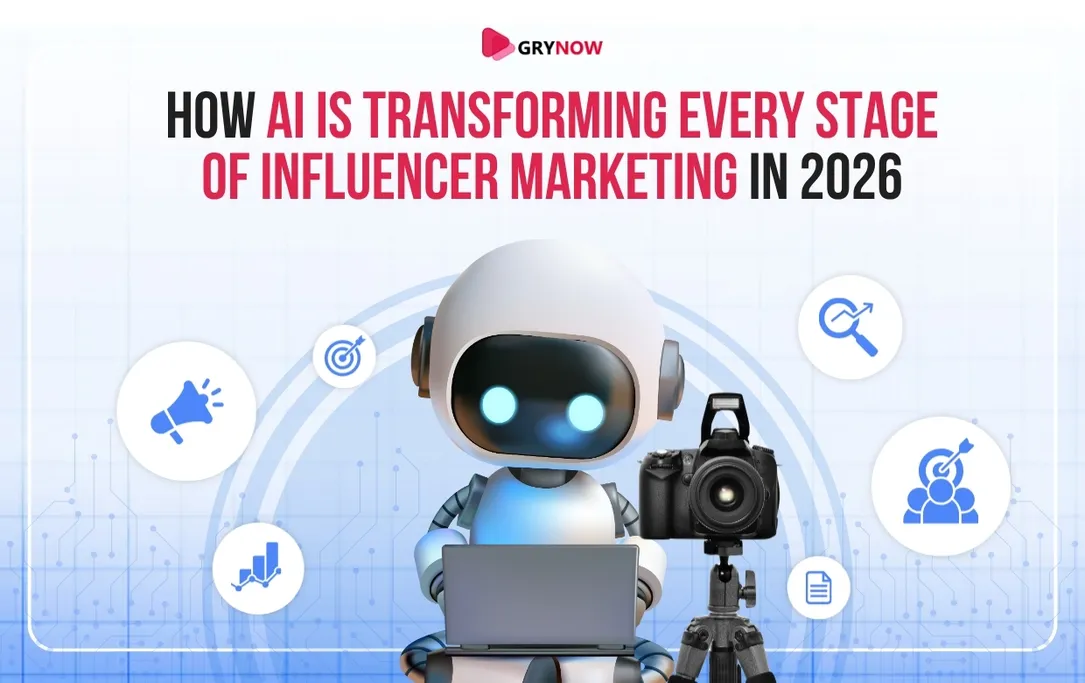
In 2026, AI isn't sitting in just one part of the influencer marketing funnel; instead, it's inserted itself into nearly every stage: discovery, vetting, briefing, outreach, paid amplification, payouts, and reporting.
Creator discovery alone now sees the highest AI adoption of any workflow stage at 36.67%.
Well, as a top influencer marketing agency in India, Grynow has tracked everything closely and breaks down where AI has taken over, where it's still catching up, and where it stays completely out of the decision.
Where Exactly Is AI Taking Over in Influencer Marketing?
From the first handshake with a creator to the final payout, AI has quietly worked its way into almost every step of the process. Here's a closer look at each stage of influencer marketing where AI has taken over.
How Does AI Now Run the Entire Creator Search?
A couple of years ago, AI tools typically helped with one task at a time, which was finding influencers, checking engagement rates, or drafting an outreach email.
The real shift in 2026 is that AI platforms now run entire sequences on their own: discovering creators, qualifying them against campaign criteria, generating the brief, sending outreach, and following up automatically, with a human only stepping in to approve decisions at set checkpoints.
For agencies, this changes how teams are structured. Instead of having someone manually own each step of the funnel, campaign managers now spend more time reviewing AI-generated shortlists and approving briefs than they do building those shortlists from scratch. The work shifts from execution to oversight, which means agencies need fewer people doing repetitive sourcing and more people making judgment calls on creative fit and strategy.
How Does AI Check If a Creator Actually Fits Your Brand?
Until recently, most AI-powered creator discovery tools worked only on follower count, engagement rate, niche tags, and audience location. That's useful, but matching a creator with the brand’s voice remains a question.
The real thing that matters in 2026 is AI that analyzes the content itself from tone, delivery style, how a creator frames product mentions, pacing, and even the sentiment in their comment sections to score creators on content fit rather than just profile fit.
Two creators can have identical follower counts and engagement rates and still be completely wrong for each other's brand fit, and this is the layer of analysis that finally accounts for that.
Influencer marketing agencies like Grynow use AI-powered dashboards that focus on whether the creator's content fits and consistently pick better-performing creators than those still relying on profile-level metrics alone.
How Does AI Spot Creators Before They Go Viral?
One of the more ambitious uses of AI right now is trying to spot creators before they blow up, with models trained on early engagement patterns that can flag a creator likely to break out 6 to 12 months before they actually trend.
This matters commercially more than it sounds.
Brands that identify and book these creators early lock in lower rates and build longer relationships before demand and price catch up. However, this model is still in an experimental capability, and the platforms building it are the first to admit it isn't perfected, but it points toward a future where creator scouting looks a lot more like early-stage talent scouting in sports or entertainment.
How does AI detect fake followers and fake engagement?
Fake followers and bought engagement have been a persistent problem in influencer marketing for years, and basic engagement-ratio checks were never a complete solution since they can be gamed just as easily as follower counts.
But AI-driven fraud detection has matured past that, cross-referencing audience behavior patterns, comment authenticity, and follower growth history to flag accounts that look real on the surface but aren't.
Even with this level of sophistication, the final call still needs to be human. AI is good at flagging anomalies and inconsistencies, but deciding whether a borderline case is worth the risk for a specific campaign is still a judgment call that depends on context AI doesn't have.
How Are Virtual Influencers Becoming a Real Trend?
Fully AI-generated influencers, virtual personas with no real person behind them, have gotten a lot of media attention, and in categories like gaming, fashion, and beauty, where a consistent, always-on brand persona makes sense, AI influencers are setting a new trend.
Also, this is one of the biggest advantages for brands because a virtual influencer never says off-brand and can be scaled across influencer marketing campaigns instantly, without the scheduling and relationship management a human creator needs.
Although this is a very early stage because marketers are still adapting to this, as the technology evolves, virtual influencers will become one of the workable options for brands that want a consistent, controllable presence.
How Is AI Changing the Way Creator Content Performs as Paid Ads?
AI's influence on influencer marketing doesn't stop at organic content; in fact, it's changing paid media too. Meta's AI-driven ad engine now analyzes billions of data points to decide which ads get shown to which users, and it increasingly rewards creative built around personas, emotional triggers, and identity signals over rigid, manually defined audience targeting.
This has a direct implication for creator content: to actually perform once it's boosted as an ad, content needs to reflect real motivators and emotional framing, not just a generic product mention.
Creators who already build content this way are leading with a feeling or an identity rather than a feature list and are positioned to perform far better in this AI-driven paid environment.
How Are AI Search Tools Making Creator Content More Important Than Ever?
This is one of the most significant emerging trends of 2026.
As AI search tools like ChatGPT, Perplexity, and Google AI Overviews become a real starting point for product research, they don't return ten links the way Google used to; instead, they synthesize one answer and cite a small set of trusted sources to back it up.
Creator content, especially video, is increasingly one of the signals these AI engines lean on to judge which brands are credible enough to cite.
This is what pushed brands to start briefing creators not just for reach anymore, but to get cited inside AI-generated answers alongside traditional SEO rather than replacing it. With traditional search volume projected to decline as more queries move to AI engines, brands treating creator content purely as a social play are already behind the brands treating it as a discovery and trust asset for AI search too.
How Is AI Changing the Way Creators Get Paid?
The old model of a flat fee for a single post is fading, replaced by hybrid compensation structures where a base fee, plus a commission tied to tracked conversions, plus performance bonuses are included.
AI is what makes this practical at scale, connecting a creator's specific post to actual attributed sales through trackable links, discount codes, and affiliate integrations, then automating the payout calculations based on real performance rather than manual reconciliation.
This shift also changes creator incentives. When pay is tied to real outcomes rather than just posting, creators are naturally pushed toward content that actually converts, not just content that looks good.
Conclusion
The honest takeaway from where influencer marketing stands in 2026 is that AI has taken over the manual, spreadsheet-heavy parts of the work that were never really adding value in the first place.
From discovery to vetting, briefing, reporting, and payouts, things are faster and more accurate than they've ever been.
Although the actual reasons influencer marketing works in the first place are trust, strategy, and creative judgment, and those are still entirely human.
The top influencer marketing agencies like Grynow, which are ahead today in India, are using AI most strategically, letting it run discovery, vetting, briefing, and reporting in the background while keeping strategy, creator approval, and relationship-building firmly in human hands.
That balance, not the AI itself, is what actually separates the agencies pulling ahead from the ones just chasing the next tool.